
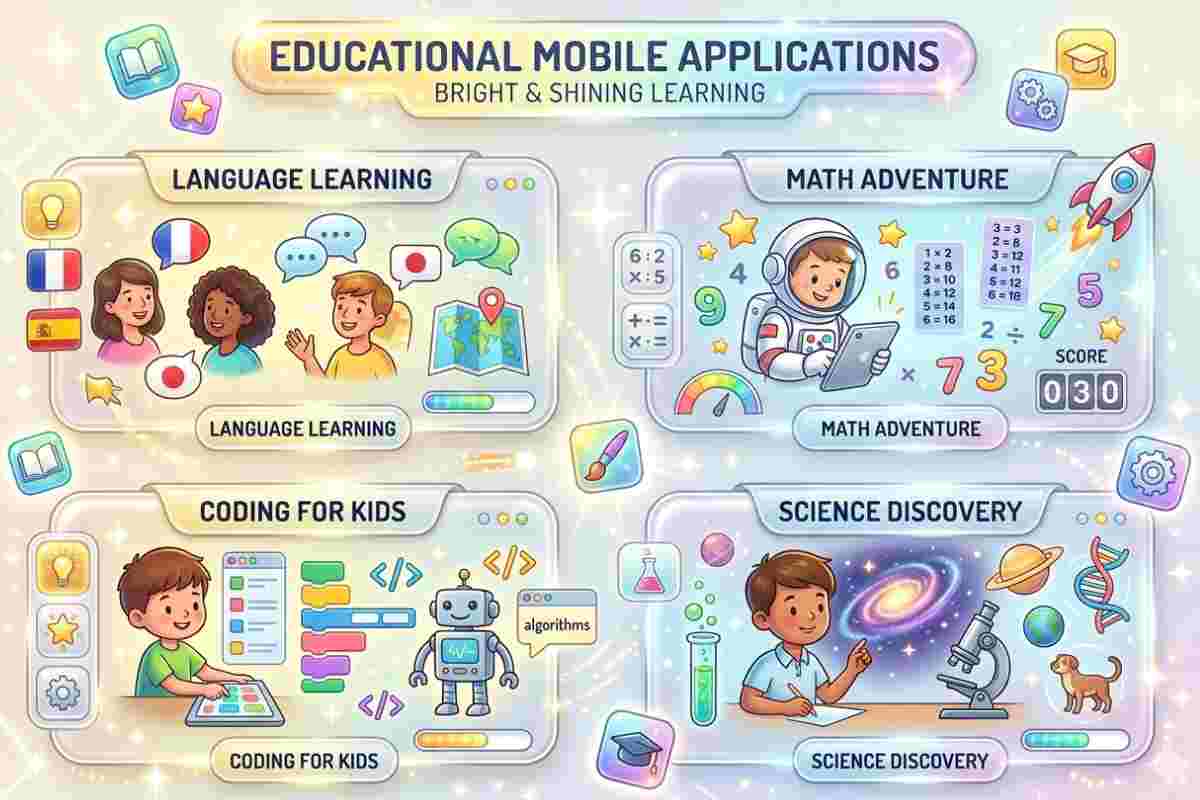
Educational mobile applications are transforming how people access knowledge globally. The rise of EdTech platforms, AI-driven learning, and hybrid education models has accelerated the need for scalable mobile learning platforms.
The global education app market was valued at over $43 billion and continues growing rapidly as institutions, startups, and corporations invest in mobile learning ecosystems.
Educational apps now support:
- Online classrooms
- Microlearning
- Corporate training
- Language learning
- Professional certification programs
- Interactive gamified learning
These platforms are built using mobile technologies, cloud infrastructure, and advanced analytics to create engaging learning environments.
Table of Contents
About – Create Educational Mobile Applications
Create Educational Mobile Applications: Institutions are adopting mobile educational applications to benefit students, teachers, and administrators. The development of technology and hyper-connectivity have driven the rise of tools such as mobile applications that allow us to carry out many of our daily activities with more practicality and immediacy, from buying private and public products or services to acquiring new knowledge.
Apps operate as portable software on mobile devices and serve different purposes, which is why the education sector has seen tremendous opportunities to promote e-learning.
Online learning is a modality that provides flexibility and personalization in the way students learn. In the same way, it is an opportunity for educational institutions of any level and specialization to provide a better experience and attention to their students.
Types of Educational Mobile Applications
Educational mobile apps can be categorized based on their learning approach and audience.
| App Type | Description | Examples |
| LMS Apps | Complete learning management systems | Moodle, Blackboard |
| Language Learning Apps | Interactive language learning | Duolingo |
| Kids Learning Apps | Basic education for children | ABCmouse |
| Exam Preparation Apps | Competitive exam preparation | BYJU’S |
| Skill Learning Platforms | Professional courses | Udemy |
| Corporate Training Apps | Employee training | Coursera for Business |
| AR/VR Learning Apps | Immersive learning environments | Google Expeditions |
Essential Features for Educational Mobile Applications
Core Features
| Feature | Description |
| User Registration | Student and teacher accounts |
| Course Management | Upload and organize courses |
| Video Streaming | Live or recorded lectures |
| Push Notifications | Assignment reminders |
| Gamification | Badges, leaderboards |
| Progress Tracking | Learning analytics |
| Offline Access | Download learning materials |
Advanced Features
| Feature | Description |
| AI-based Learning | Personalized learning paths |
| Voice Assistant | Voice learning interaction |
| AR/VR Learning | Virtual labs and simulations |
| Blockchain Certificates | Secure certification |
| Chatbots | Automated student support |
E-Learning Through Mobile Applications
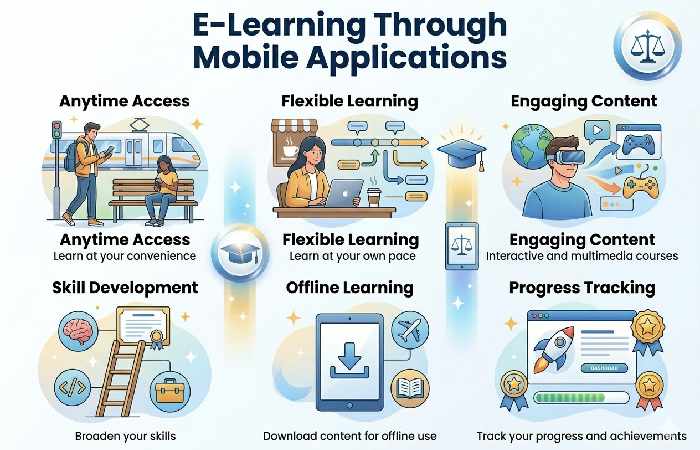
E-learning is a learning method in a digital environment that manages the entire course, content, objectives, and goals. Also, it is a communication channel between students and teachers within the school.
Likewise, it contains the didactic resources (videos, documents, bibliography, activities, etc.). Finally, it promotes interactivity and gamification through webinars or discussion forums aligned with a pedagogical approach appropriate to the level and objectives of the course.
Another element of great importance is the actions of teachers, who must provide guidance when necessary and evaluate students periodically.
Why Develop an Educational Mobile Applications?
Thinking about developing a mobile application for your educational institution has a high investment value. Still, its long-term benefits allow you to give more personalized and immediate attention to your students, promote and reinvent your e-learning services and even save money—operational costs for your administrative staff.
Also, it helps you adapt to new trends since online education has increased due to the Covid-19 pandemic since it is essential to provide digital solutions that allow all students to access and manage their educational courses more easily online—a new normal.
Significant growth of mobile educational applications is expected from 2023, and the company Technavio calculates that it increased by 26% and will continue to do so in 2024; its boom in Latin America is also highlighted.
5 Benefits of Creating Educational Mobile Applications
Educational mobile applications not only help you complement your students’ studies but also allow you to implement a comprehensive portable learning system that empowers the student thanks to its practicality and availability.
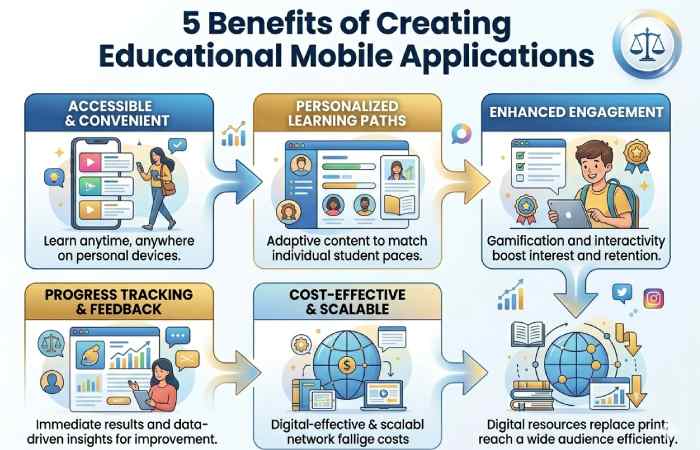
Here are five reasons to bet on these platforms:
1. Develop Learning Methods Based on Student Needs
With the development of an educational app, it will be possible for you to design academic courses that not only fulfill related to education purpose but are also better adapted to each student’s availability and learning pace.
It is a solution that integrates all the aspects that make up their learning process and allows them to manage their status and their complementary documentation and activities from a single source at their fingertips, even if they are away from school or a computer.
2. Extend Knowledge Inside and Outside the Classroom
Academic supplements (bibliographic material, slides, documentaries, etc.) benefit the educational process. Still, they can prevent progress in the student’s training when it is impossible to access them because they are in the facilities or stored on a computer. In addition, they can’t wear it all the time.
On the other hand, when these documents are stored within the app. The student can review them at any time and place they require.
3. The Student is an Active Agent, Also Interacts and Participates More
Student engagement is always a concern for institutions that want to implement a mobile app. However, these interactive tools encourage two-way communication and help students better retain knowledge.
Thus, the student can:
- Decide how, when, and where to access the necessary pedagogical resources to strengthen their learning.
- Choose from multimedia learning materials, various learning sessions such as live broadcasts with teachers, seminars, and forums where you can ask questions.
- Control study time and manage your daily routine through calendars and notifications even if you are not on the platform.
- You have the autonomy to view and manage your data, progress. And educational processes whenever you require it from the app.
- It breaks with the passive learning experience because. In addition to listening and visualizing, you will be able to interact with the resources.
4. It Favors Two-Way Communication Between Students, Teachers, and Administrators
Communication between all application users is also favored because an instant messaging section can be integrated to open conversations with teachers and other students, facilitating access to files to share them on the same channel.
In addition, it is possible to communicate with the administrative staff to resolve doubts. Manage student data, receive monthly payments, annuities or per course, etc.
5. Concentrate And Ideas Relevant Course Information – Create Educational Mobile Applications
Another advantage of mobile educational applications is that they allow you to have better control over the most critical events and documentation for the administrative and academic management of the institution.
Well, it schedules and informs students through notifications about the dates of exams. Homework and project deliveries, registration requests, the requirements for enrollment or development of the course, etc.
Monetization Models for Educational Apps
| Monetization Model | How It Works | Typical Pricing | Example Platforms | Resource Link |
| Subscription Model | Users pay monthly or yearly to access premium courses and features. | $5 – $80 / month | Coursera, MasterClass | https://www.coursera.org |
| Freemium Model | Basic features are free; premium features require payment. | $6 – $15 / month premium | Duolingo, Quizlet | https://www.duolingo.com |
| Course Purchase Model | Users buy individual courses separately. | $10 – $200 per course | Udemy | https://www.udemy.com |
| Institutional Licensing | Schools or companies buy bulk access for students or employees. | $5,000 – $100,000 yearly contracts | Coursera for Business | https://www.coursera.org/business |
| Certification Fees | Courses are free but certificates require payment. | $30 – $300 per certificate | edX | https://www.edx.org |
| In-App Purchases | Users buy extra learning tools, materials, or features inside the app. | $1 – $50 per purchase | Duolingo Gems, Photomath Premium | https://www.duolingo.com |
| Advertising Revenue | Free apps display ads to generate revenue from advertisers. | $1 – $20 CPM (per 1000 views) | Free learning apps | https://ads.google.com |
| Corporate Training Packages | Businesses purchase training programs for employees. | $50 – $400 per employee | LinkedIn Learning | https://www.linkedin.com/learning |
| One-Time App Purchase | Users pay once to download the educational app. | $1 – $20 one-time fee | Premium learning apps | https://play.google.com |
| Sponsorship & Partnerships | Brands sponsor courses or educational programs. | $5,000 – $500,000 partnerships | University partnerships | https://www.edx.org |
Country-Wise Cost to Create Educational Mobile Applications
| Country | Small App | Medium App | Enterprise App | Hourly Developer Rate |
| USA | $25,000 | $55,000 | $300,000+ | $100–$150 |
| UK | $20,000 | $50,000 | $160,000 | $80–$120 |
| Canada | $17,000 | $40,000 | $140,000 | $90–$140 |
| Australia | $18,000 | $45,000 | $150,000 | $80–$120 |
| India | $8,000 | $20,000 | $150,000 | $20–$50 |
India remains one of the most cost-effective countries for mobile development while maintaining high quality.
Platform-Wise Development Cost
| Platform | Estimated Cost |
| Android App | $30,000 – $45,000 |
| iOS App | $40,000 – $50,000 |
| Cross-Platform App | $35,000 – $40,000 |
Cross-platform frameworks help reduce development costs because a single codebase runs on both Android and iOS.
Cost Breakdown of Educational App Development
| Development Stage | Estimated Cost |
| Market Research | $3,000 – $10,000 |
| UI/UX Design | $5,000 – $25,000 |
| Frontend Development | $15,000 – $70,000 |
| Backend Development | $20,000 – $90,000 |
| Testing | $5,000 – $20,000 |
| Deployment | $2,000 – $8,000 |
Top Competitors in Educational Mobile Applications
| Platform | Type | Pricing |
| Duolingo | Language learning | Free / $7-$12 month |
| Coursera | Professional courses | $39-$79 month |
| Udemy | Online courses | $10-$200 per course |
| BYJU’S | K-12 learning | $150-$400 yearly |
| Khan Academy | Nonprofit learning | Free |
Top Educational Mobile App Development Companies
| Company | Country | Starting Price |
| Fueled | USA | $50,000+ |
| Hyperlink InfoSystem | India | $10,000+ |
| Intellectsoft | USA | $40,000+ |
| Eleks | Ukraine | $30,000+ |
| Appinventiv | India | $20,000+ |
| Y Media Labs | USA | $80,000+ |
| OpenXcell | India | $15,000+ |
| Techugo | India | $25,000+ |
Challenges in Educational Mobile Application Development
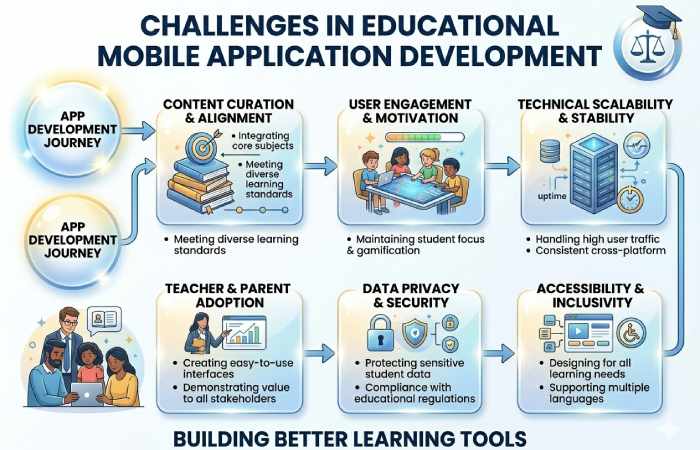
| Challenge | Solution |
| Low Student Engagement | Gamification |
| High Development Cost | MVP strategy |
| Data Security | End-to-end encryption |
| Content Scalability | Cloud infrastructure |
| Multi-device Compatibility | Cross-platform development |
Future Trends in Educational Mobile Applications
1 AI-Powered Learning
Artificial intelligence will personalize learning paths and automatically adjust course difficulty.
2 Augmented Reality Education
AR apps allow students to interact with 3D objects and virtual labs.
3 Microlearning Platforms
Short video lessons designed for quick learning.
4 Blockchain Certification
Secure digital certificates for academic credentials.
5 Adaptive Learning Systems
Apps analyze student behavior and adapt learning modules accordingly.
Future Scope of Educational Mobile Applications
The demand for educational mobile applications will continue to increase due to:
- Global digital transformation
- Remote learning adoption
- AI-driven personalized education
- Corporate upskilling demand
- Government digital education programs
Experts predict the EdTech industry could exceed $400 billion globally by 2030, making educational apps one of the fastest-growing digital sectors.
Final Thoughts
Creating educational mobile applications offers institutions and startups a powerful way to deliver flexible, scalable, and interactive learning experiences. With the right technology stack, monetization strategy, and feature set, educational apps can generate significant revenue while improving access to knowledge worldwide.
From AI-powered learning platforms to immersive AR classrooms, educational apps will continue to reshape how people learn in the digital age.