 Kashifa Jafar
Technology Writer & Contributor
Kashifa Jafar is a technology writer and
contributor with 4+ years of experience
creating clear and reader-friendly
technology content.
Read Full Bio of Author →
Kashifa Jafar
Technology Writer & Contributor
Kashifa Jafar is a technology writer and
contributor with 4+ years of experience
creating clear and reader-friendly
technology content.
Read Full Bio of Author →
 Sameena Begum
Technology & Digital
Content Reviewer
Sameena Begum is a technology and digital content reviewer who reviews selected articles to help ensure that information is presented clearly, accurately, and responsibly.
Read Full Bio of Reviewer →
Sameena Begum
Technology & Digital
Content Reviewer
Sameena Begum is a technology and digital content reviewer who reviews selected articles to help ensure that information is presented clearly, accurately, and responsibly.
Read Full Bio of Reviewer →
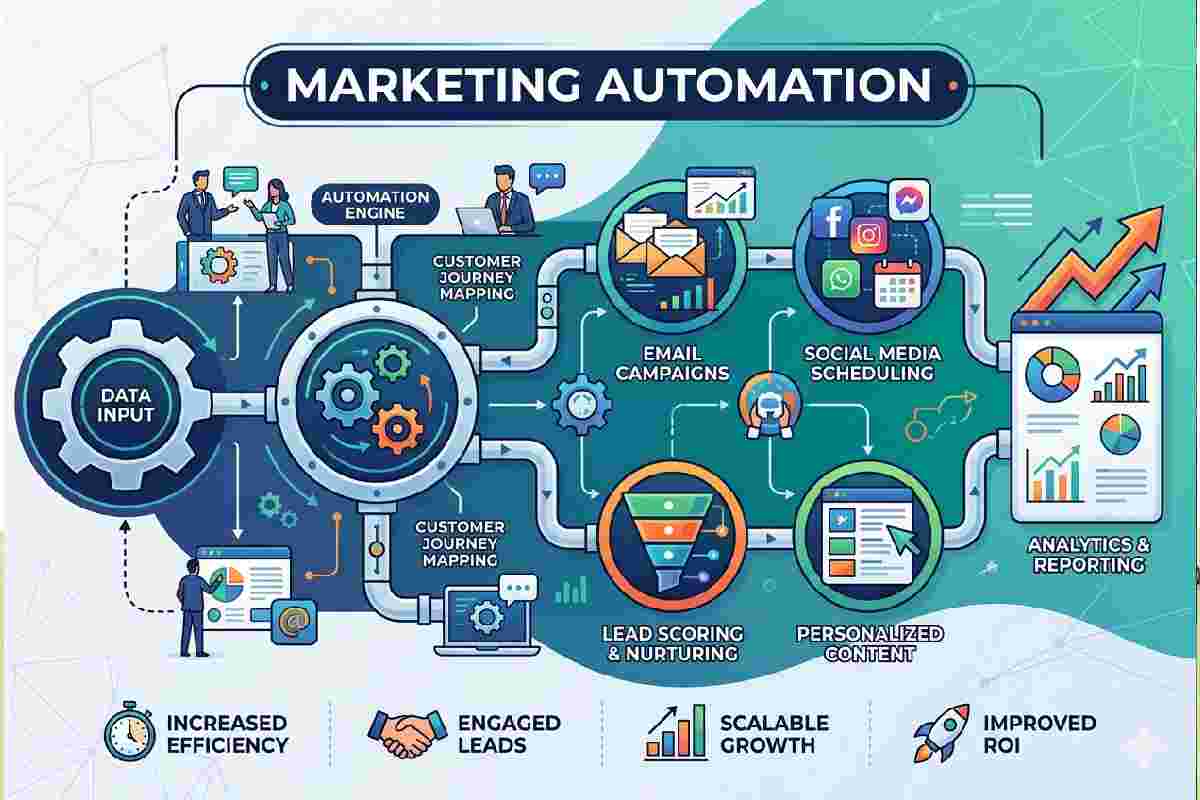
Marketing automation is software that automatically manages (and therefore streamlines) marketing processes within multifaceted digital marketing campaigns. It can include email marketing and social media marketing, live chat, website monitoring, and lead scoring.
Table of Contents
What is Marketing Automation?
Marketing automation refers to software platforms and technologies that automate repetitive marketing tasks such as email campaigns, social media posting, lead nurturing, and customer segmentation. The goal is to improve marketing efficiency, personalize communication, and increase conversions across multiple digital channels.
Instead of manually managing campaigns, marketers use automation tools to create automated workflows that trigger actions based on user behavior (such as visiting a website, clicking an email, or downloading a resource).
Example of Marketing Automation Workflow
| Step | Automated Action |
| Visitor signs up for newsletter | Welcome email sent automatically |
| User downloads ebook | Lead added to CRM and scored |
| Lead opens multiple emails | Sales team notified |
| Customer buys product | Upsell email triggered |
Key Components of Marketing Automation
- Email marketing automation
- Lead generation and lead scoring
- Customer relationship management (CRM) integration
- Social media automation
- Customer journey tracking
- Analytics and reporting
Why Businesses Use Marketing Automation
- Increase lead conversions
- Personalize marketing campaigns
- Reduce manual work
- Track customer behavior
- Improve marketing ROI
Marketing automation platforms range from free tools for startups to enterprise solutions costing thousands per month, depending on features and number of contacts.
Marketing automation works best when combined with content marketing strategies that deliver relevant information to prospects at every stage of the customer journey.
Types of Tools for Marketing Automation
If you read ten different articles, you will find ten lists of what marketing automation software should be. Also, those lists will be as long or as limited as you imagine. Depending on what each writer understands as “marketing activities.” Some will include operating systems for inventory management, pricing, distribution (e.g., sales channels), revenue management, and competitive intelligence under the “marketing automation tools” category. With that in mind, here’s a list of potential automation tools.
- Customer Relationship Management (CRM): Automates sales processes and manages customer, order, and product data, which can be used for marketing automation.
- Sales Force Automation: Manages sales processes, manages data, a and provides analytics.
- Email Marketing: Makes it easy to set up online forms and autoresponders, as well as various reports (click-through rates, open email rates, unsubscribes, etc.)
- Social Media: Automate multiple aspects of social media marketing, including posting, scheduling, monitoring, and content analytics.
- Workflows: Remove the human element from business processes, including marketing processes.
- Lead Management: Automates the generation, scoring, and use of sales or marketing leads.
- Analytics: Visualize and identify patterns in market and customer data.
As you can see, today’s digital marketing campaigns have many components. As a result, various solutions are available, from point solutions that need to be integrated to comprehensive marketing automation solutions that support all or most of the tools and capabilities listed above.
Finally, marketing helps you understand a potential buyer’s behavior online (digital body language). Indicating what product or service they are interested in and where they are in the buying process. Based on these observations, marketers can encourage the prospect to buy throughout the process with high-value content.
Many businesses use automation tools to schedule and optimize video marketing campaigns across multiple digital channels.
Top 10 Marketing Automation Tools
Below is a comparison of the most widely used marketing automation software in 2026.
| Tool | Best For | Key Features | Starting Price | Website |
| HubSpot Marketing Hub | All-in-one marketing platform | CRM, automation workflows, analytics | $15/month | https://hubspot.com |
| ActiveCampaign | Small–medium businesses | Email automation, CRM, predictive sending | $29/month | https://activecampaign.com |
| Mailchimp | Beginners & startups | Email automation, templates, analytics | Free / $13/month | https://mailchimp.com |
| Salesforce Marketing Cloud | Large enterprises | AI marketing, customer journeys | $1,250/month | https://salesforce.com |
| Marketo Engage | B2B enterprises | Advanced segmentation, lead management | Custom pricing | https://adobe.com |
| GetResponse | Ecommerce automation | Funnels, webinars, email automation | $19/month | https://getresponse.com |
| Brevo (Sendinblue) | Affordable automation | Email + SMS marketing automation | $25/month | https://brevo.com |
| Keap | Small businesses | CRM + automation + sales pipeline | $79/month | https://keap.com |
| Omnisend | Ecommerce marketing | SMS, push notifications, email automation | Free / $16/month | https://omnisend.com |
| SharpSpring | Marketing agencies | CRM, automation workflows | $550/month | https://sharpspring.com |
Advantages of Marketing Automation
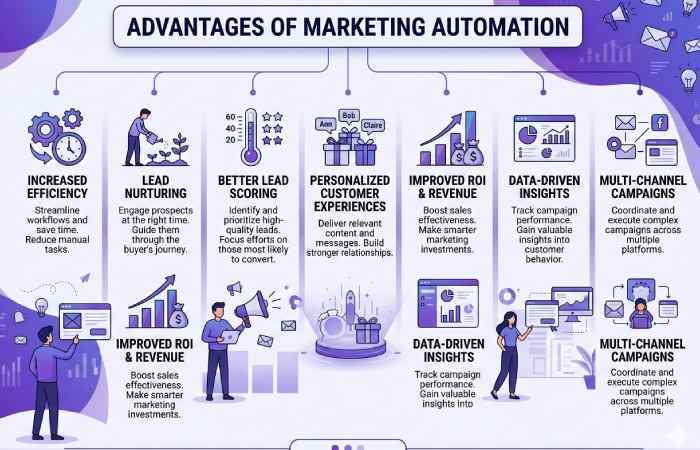
Marketing automation provides different benefits for businesses of any size. It helps in many aspects of digital sales and marketing, such as finding and nurturing leads, customer acquisition, cross-selling, and up-selling.
Marketing automation enables industry teams to do more with less. However, 63% of companies expect to realize benefits from marketing automation after just six months of going live. So how can you maximize your profits by investing in automation?
These are some of the most important advantages of marketing automation.
1. Higher conversion rates
When lead generation campaigns are managed with marketing automation. Clean customer data makes it easy to identify and target customers and make the right offers to the right contacts. Therefore, interactions with real potential customers occur, which increases the possibility of making a sale.
2. Stop Wasting Time on Ineffective Campaigns
Get opportunity and revenue data from the CRM system for complete visibility of what’s working and not. Stop planning based on intuition. Instead, use data to make informed decisions about marketing campaigns and allocate marketing budgets to those with the highest financial gain.
3. Keep Everything in Order
Marketing automation classifies transactions, harmonizes activities, creates achievable schedules, and coordinates internal teams to achieve goals. As a result, it makes everything work better.
4. Increased Employee Productivity
With the right marketing solution, employees can forget repetitive manual tasks and focus on strategic issues. As a result, it will make your work easier, more productive, and more enjoyable.
Automated workflows can distribute content through various online video sharing platforms to increase visibility and audience engagement.
Marketing Automation Workflow Example
A typical automated marketing funnel includes the following stages:
Lead Generation
- Landing pages
- Lead magnets
- Website forms
- Social media ads
Lead Scoring
Automation assigns scores based on:
| Action | Score |
| Website visit | +5 |
| Email open | +10 |
| Click link | +20 |
| Download ebook | +30 |
| Request demo | +50 |
When leads reach a certain score, they are automatically sent to the sales team.
Companies often connect marketing automation software with their business blog to automatically promote new content to subscribers.
Marketing Automation Pricing by Platform
| Platform | Starting Price | Best For | Website |
| HubSpot Marketing Hub | $20/month | Small to Enterprise | https://www.hubspot.com |
| Marketo Engage | $895/month | Enterprise | https://www.adobe.com |
| ActiveCampaign | $29/month | Small Business | https://www.activecampaign.com |
| Mailchimp | $13/month | Email Marketing | https://mailchimp.com |
| Salesforce Marketing Cloud | $1250/month | Enterprise | https://www.salesforce.com |
| Brevo (Sendinblue) | $25/month | Startups | https://www.brevo.com |
| GetResponse | $19/month | Ecommerce | https://www.getresponse.com |
| Zoho Marketing Automation | $19/month | SMEs | https://www.zoho.com |
Marketing Automation Cost by Country
| Country | Average Monthly Cost | Agency Cost | Resource |
| USA | $500 – $3000 | $2000 – $10,000 | https://www.hubspot.com |
| UK | $400 – $2500 | $1500 – $7000 | https://www.marketingweek.com |
| Canada | $450 – $2700 | $1800 – $8000 | https://www.getresponse.com |
| Australia | $350 – $2200 | $1200 – $6000 | https://www.activecampaign.com |
| India | $100 – $800 | $500 – $3000 | https://www.zoho.com |
| Germany | $500 – $2800 | $2000 – $9000 | https://www.salesforce.com |
Top Marketing Automation Platforms (Competitor Analysis)
| Platform | Market Share | Key Features | Price |
| HubSpot | 29% | CRM, Email, Automation | $20+ |
| Salesforce | 18% | AI automation, CRM | $1250+ |
| Marketo | 14% | Enterprise automation | $895+ |
| ActiveCampaign | 11% | Email + automation | $29+ |
| Mailchimp | 10% | Email marketing | $13+ |
| Zoho | 7% | CRM integration | $19+ |
| GetResponse | 6% | Webinar automation | $19+ |
Marketing Automation ROI Statistics
Companies invest in automation mainly because of its proven ROI.
| Metric | Improvement |
| Lead Conversion | +77% |
| Sales Productivity | +14.5% |
| Marketing Overhead Reduction | −12.2% |
| Email Open Rates | +70% |
| Customer Retention | +36% |
Average ROI
Marketing automation provides an average $5.44 return for every $1 spent.
Automated campaigns frequently direct visitors to dedicated landing pages designed to generate leads and conversions.
Marketing Automation vs Traditional Marketing
| Factor | Marketing Automation | Traditional Marketing |
| Cost Efficiency | High | Medium |
| Personalization | Advanced | Limited |
| Analytics | Real-time | Delayed |
| Lead Tracking | Automated | Manual |
| Scalability | Very High | Limited |
| ROI | High | Moderate |
Automation Features Businesses Should Look For
When selecting automation software, companies should evaluate the following features:
Essential Features
- Email campaign automation
- CRM integration
- Lead scoring
- Landing page builder
- Customer segmentation
Advanced Features
- AI-powered marketing analytics
- Predictive lead scoring
- Behavioral targeting
- Omnichannel marketing automation
- Dynamic content personalization
Most automation platforms include customizable email marketing templates that help businesses create professional campaigns more efficiently.
AI in Marketing Automation
Artificial Intelligence is transforming marketing automation with:
| AI Technology | Use Case |
| Predictive Analytics | Predict customer behavior |
| Chatbots | Automated customer support |
| Machine Learning | Personalization |
| NLP | Email automation |
| AI Recommendations | Product suggestions |
Example: Amazon’s recommendation engine generates nearly 35% of its sales.
Marketing Automation Use Cases by Industry
| Industry | Automation Strategy |
| Ecommerce | Abandoned cart emails |
| SaaS | Free trial nurturing |
| Healthcare | Appointment reminders |
| Education | Student onboarding |
| Finance | Loan application follow-ups |
| Real Estate | Property lead nurturing |
Marketing Automation Campaign Examples
1 Welcome Email Automation
Trigger: User subscribes to newsletter.
Sequence:
- Welcome email
- Brand story email
- Product recommendations
- Discount offer
2 Abandoned Cart Automation
Trigger: Customer leaves cart.
Sequence:
- Reminder email
- Discount coupon
- Urgency email
Common Marketing Automation Mistakes
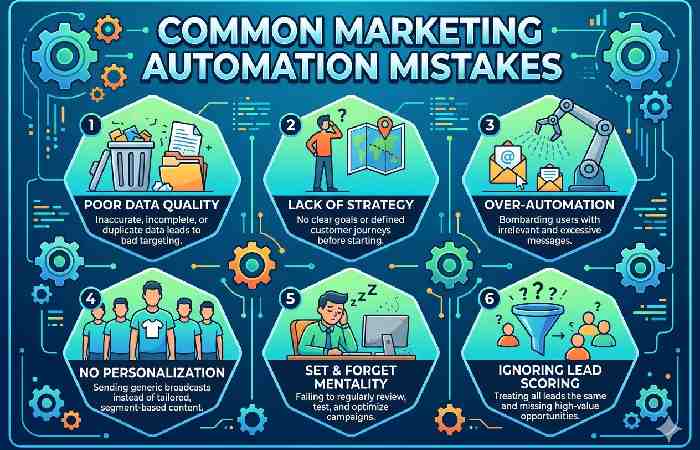
Avoid these mistakes to maximize automation results:
- Over-automation without personalization
- Poor lead segmentation
- Sending too many emails
- Ignoring analytics data
- Not integrating CRM systems
Key Marketing Automation Metrics
| Metric | Meaning |
| Lead Conversion Rate | % of leads that become customers |
| Email Click Rate | Engagement level |
| Customer Lifetime Value | Revenue per customer |
| Cost per Lead | Marketing efficiency |
| Customer Acquisition Cost | Total cost to gain a customer |
Future Trends in Marketing Automation
The next generation of automation will include:
1 AI-Driven Personalization
Content will be customized for every user.
2 Predictive Marketing
Algorithms will predict purchasing behavior.
3 Voice Search Marketing
Automation will integrate with voice assistants.
4 Hyper-Personalized Customer Journeys
AI will generate dynamic content.
5 No-Code Marketing Automation
Non-technical marketers will build automation flows.
Marketing Automation Strategy Framework
A high-performing automation strategy includes the following stages:
| Stage | Strategy |
| Awareness | Content marketing |
| Consideration | Lead nurturing emails |
| Decision | Product demos |
| Purchase | Sales automation |
| Retention | Loyalty campaigns |
Marketing Automation Tool Stack
Companies often combine multiple tools:
| Category | Tool Examples |
| CRM | Salesforce, HubSpot |
| Email Automation | Mailchimp, ActiveCampaign |
| Social Media Automation | Hootsuite, Buffer |
| Analytics | Google Analytics |
| Landing Pages | Unbounce |
| Chatbots | Drift |
Best Marketing Automation Agencies
| Agency | Country | Starting Price | Website |
| SmartBug Media | USA | $5000/month | https://www.smartbugmedia.com |
| Ironpaper | USA | $4000/month | https://www.ironpaper.com |
| WebFX | USA | $3000/month | https://www.webfx.com |
| Disruptive Advertising | USA | $3500/month | https://www.disruptiveadvertising.com |
| GrowthRocks | Europe | $2500/month | https://www.growthrocks.com |
| iProspect | Global | $5000/month | https://www.iprospect.com |
Marketing Automation Implementation Timeline
| Phase | Time |
| Strategy Planning | 2 weeks |
| Tool Selection | 1 week |
| Integration | 2-4 weeks |
| Campaign Setup | 2 weeks |
| Testing | 1 week |
| Optimization | Ongoing |
Total implementation time: 6–10 weeks
Marketing Automation Funnel Optimization
| Funnel Stage | Automation Strategy |
| Top of Funnel | Lead magnets |
| Middle of Funnel | Educational email sequences |
| Bottom of Funnel | Personalized offers |
| Retention | Loyalty programs |
Free vs Paid Marketing Automation Tools
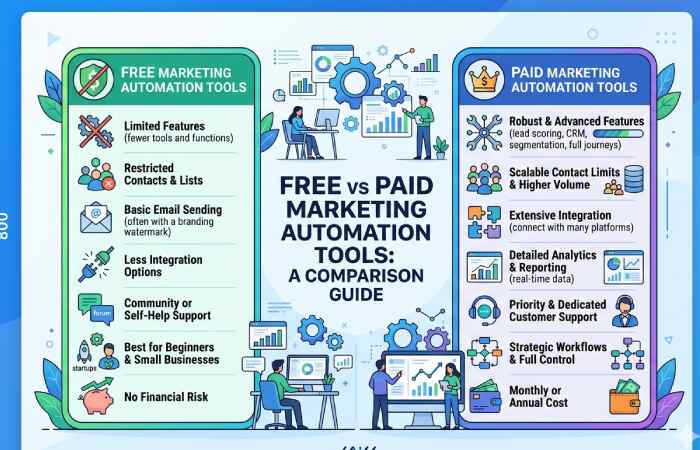
Free Marketing Automation Tools
Theare ideal for startups, bloggers, and small businesses.
| Tool | Free Plan Limits | Key Features |
| Mailchimp | 250 contacts, 500 emails/month | Email marketing automation |
| HubSpot Free CRM | 1000 contacts | Basic marketing automation |
| Brevo | 300 emails/day | Email + SMS campaigns |
| Omnisend | 250 contacts | Ecommerce automation |
| Sender | 2500 subscribers | Email automation workflows |
Advantages of Free Tools
- No upfront cost
- Easy setup
- Suitable for beginners
- Good for testing automation strategies
Limitations
- Limited automation features
- Branding in emails
- Contact limits
- Limited analytics
Paid Marketing Automation Tools
Paid tools are designed for growing businesses and enterprises that need advanced automation.
| Platform | Price Range | Best For |
| HubSpot | $15 – $3,600/month | All-in-one marketing |
| ActiveCampaign | $29 – $149/month | SMB automation |
| Salesforce Marketing Cloud | $1,250 – $4,200/month | Enterprise marketing |
| Marketo | Custom pricing | B2B enterprises |
| Keap | $79 – $199/month | Small business CRM |
Advantages of Paid Tools
- Advanced automation workflows
- AI-powered marketing insights
- Unlimited contacts and campaigns
- CRM integration
- Detailed analytics and reporting
Limitations
- Higher cost
- Complex setup
- Training required for teams
Conclusion
Marketing automation refers to software platforms and technologies designed for marketing departments and organizations to more effectively market on multiple channels online and automate repetitive tasks.
Kashifa Jafar is a technology writer and contributor with 4+ years of experience covering AI, cloud computing, mobile technology, software, networking, cybersecurity, and emerging technology.
View Author Profile →
Sameena Begum is a technology and digital content reviewer who reviews selected articles to help ensure that information is presented clearly, accurately, and responsibly.
View Reviewer Profile →