
Table of Contents
Introduction
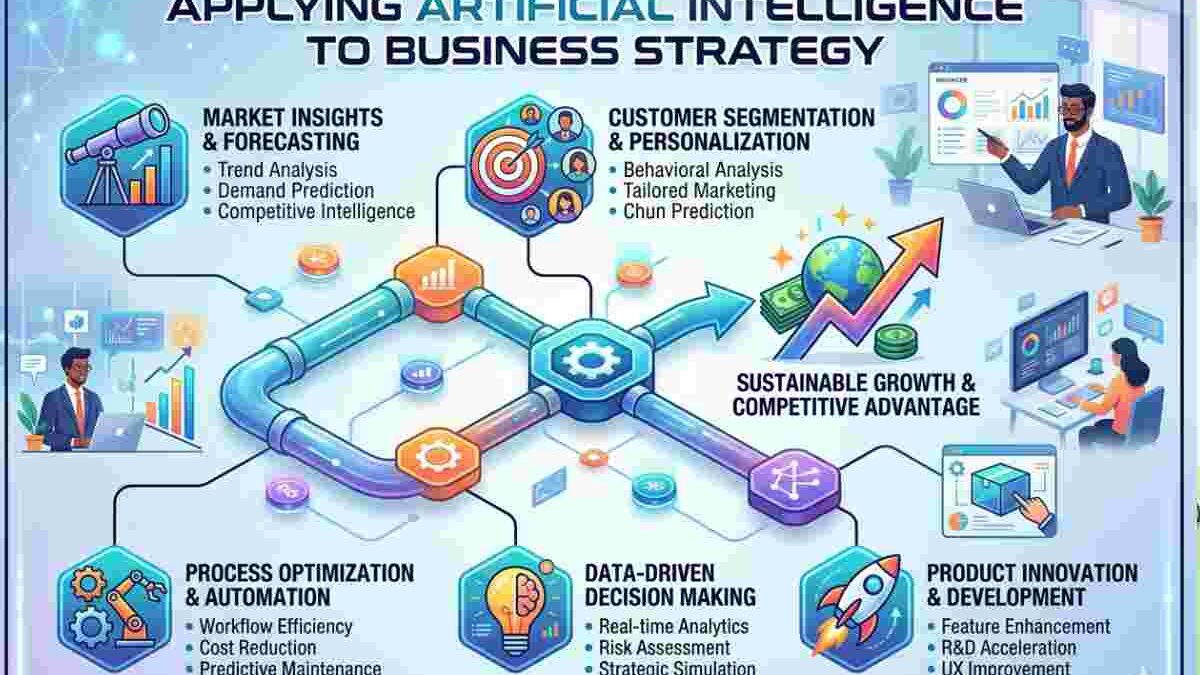
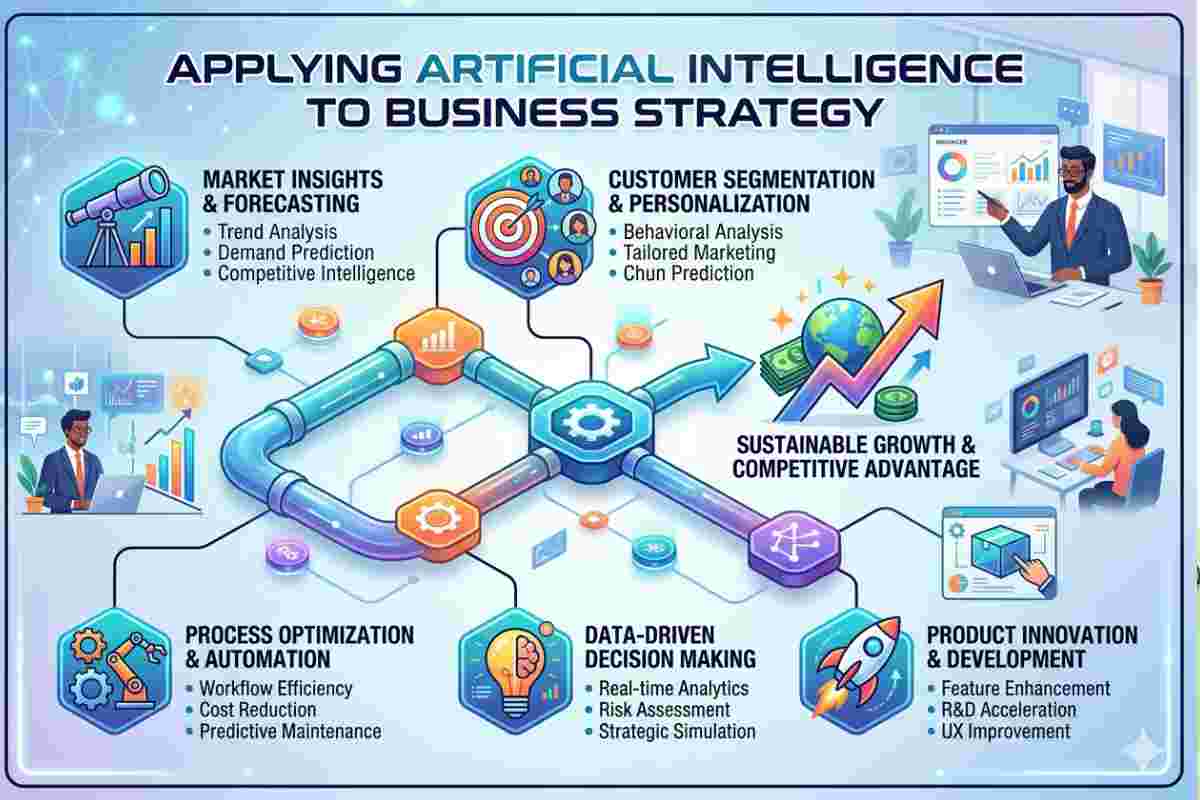
The business strategy is undergoing a digital transformation around Artificial Intelligence. Reinventing the way companies compete and develop. When implemented comprehensively, Artificial Intelligence improves productivity and reduces costs promoting the most creative jobs and generating new growth opportunities.
Artificial Intelligence is a set of tools and technologies applied in different industries. Companies are currently adopting AI tools to keep pace in their industry and, for example, incorporating technological measurement and reporting tools. That facilitates the management and adds differential value to their services.
Integrate AI into Business Strategy
- Accept Artificial Intelligence: AI is an evolutionary technology. He gets smarter as he learns, so give him some time.
- Learn from other companies: If other companies have been able to adopt AI successfully, we must analyze the needs of the business strategy so as not to be left behind and be able to be competitive.
- Relate AI to performance indicators: Before integrating AI, the company’s KPIs (Key Performance Indicators) must be considered. Analyze what can be improved and what will allow us to advance the incorporation of Artificial Intelligence in the business strategy.
- Consider the impact of AI on people: Collaboration between people and also AI tools is essential. As a result, AI will have a favourable implication in our lives.
- Create an AI culture in the company: Managers will need to introduce AI tools progressively and transparently. They were promoting good knowledge so that opportunities are maximize for all.
Role of Artificial Intelligence in Modern Business Strategy
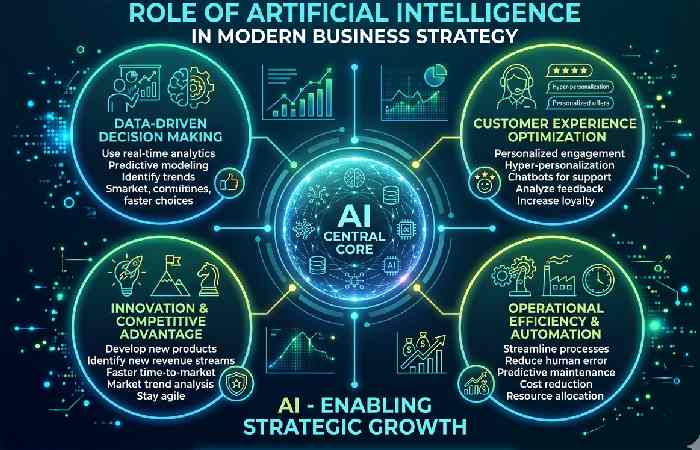
Artificial Intelligence is now considered a core pillar of corporate strategy, similar to finance, operations, and marketing. Organizations are no longer experimenting with AI—they are embedding AI into strategic planning, forecasting, and operational decision-making.
According to McKinsey Global Institute, AI could add $13 trillion to the global economy by 2030, primarily through productivity improvements and innovation.
Key Strategic Roles of AI
- Predictive analytics for strategic planning
- Automated operational optimization
- Customer behavior forecasting
- Market trend analysis
- Risk management and fraud detection
- Competitive intelligence
Companies such as Amazon, Google, Tesla, and Netflix have built their entire business strategy around AI-driven decision making.
How is AI Transforming Business Strategy?
Digital Transformation in Different Sectors
AI is rapidly picking up the pace and transforming different industries. In medicine, AI is now taking on the role of a clinical assistant to help make quick and reliable diagnoses.
Data-Driven Decision Making
Before the rise of AI, finance managers and departments had to rely on incomplete and poorly structured data. Today, Artificial Intelligence feeds on significant data sources. It is making intensive use of them and providing an optimal visualization of the data. As a result, it makes it easier for managers and executives to make decisions. The incorporation of Artificial Intelligence tools allows working on information that is well segment and processed according to the interest of the business.
They provide actionable information
Implementing AI in processes offers direct predictions and meaningful information about the data collected. Artificial Intelligence allows the automation of decision-making based on prescriptive analysis. Its ability comes from real-time data feedback. Hence, improving rigid models and ensuring that the next decision is better than the last.
Top Artificial Intelligence Tools Used in Business Strategy
| AI Tool | Main Purpose | Pricing | Official Website |
| IBM Watson | AI analytics & automation | $99 – $5000/month | https://www.ibm.com/watson |
| Google Vertex AI | Machine learning platform | $0.10 – $3 per training hour | https://cloud.google.com/vertex-ai |
| Microsoft Azure AI | AI development tools | $9 – $1000+/month | https://azure.microsoft.com |
| Salesforce Einstein | AI-powered CRM | $50 – $500/user/month | https://www.salesforce.com |
| DataRobot | Automated machine learning | $2000 – $10000/year | https://www.datarobot.com |
| H2O.ai | Predictive AI platform | Free – $50,000 enterprise | https://www.h2o.ai |
| OpenAI API | AI models & automation | $0.002 – $0.06 per 1K tokens | https://openai.com |
What Sectors does Artificial Intelligence Benefit?
Independent analysis tools can be applied in different business areas to optimize the production process and customer relationships.
- Sales and Marketing: Implementing Machine Learning together with predictive algorithms, which repeat patterns and trends. In this way, data and tools are available in real-time for fast and complete analysis.
- Customer service: Virtual assistants and chatbots can reproduce and also interpret human language. These can be apply in online chats on web pages, answering phone calls or solving more complex problems.
- Finance: Deep learning helps recognize potential investment risks in business strategy.
Advantages Of Data Analysis And Business Intelligence
- Real-Time: Decision-making on live data through continuous and also periodic reports.
- Accessibility: It is a multi-device service, with automatiexportedrts, export to excel or pdf.
- Anti-aggregation: Each business unit is analyzed according to its characteristics, which allows a global vision, avoiding aggregation or analysis by averages.
- Granularity: Provides a business control capacity at a level of detail impossible to manage by other means.
- Personalization: Each user of the system receives the necessary information for their area.
- Scalability: The system grows with the business, and also the business grows more agile thanks to the system.
- Savings: Allows a reduction of costs in hours and person, systems, and suppliers.
- Professionalism: Improves the perception of the company’s brand, which provides an intangible asset beyond direct benefit.
- Loyalty: Allows segmented commercial actions, which are highly effective and economical.
Country-Wise Artificial Intelligence Implementation Costs
AI adoption costs vary significantly depending on technology infrastructure, labor costs, and cloud services.
| Country | Average AI Project Cost | AI Developer Salary | Resource Link |
| USA | $50,000 – $500,000 | $120,000/year | https://www.statista.com |
| UK | $40,000 – $300,000 | $95,000/year | https://www.gov.uk |
| India | $10,000 – $80,000 | $25,000/year | https://www.nasscom.in |
| Germany | $35,000 – $250,000 | $90,000/year | https://www.bmwk.de |
| Canada | $30,000 – $200,000 | $85,000/year | https://www.ic.gc.ca |
| Australia | $25,000 – $180,000 | $88,000/year | https://www.industry.gov.au |
Strategic AI Implementation Framework for Businesses
A successful AI strategy follows a structured implementation model.
- Business Problem Identification
Companies must identify specific strategic problems AI can solve.
Examples:
- Customer churn prediction
- Sales forecasting
- Supply chain optimization
- Data Infrastructure Development
AI systems require large datasets and cloud infrastructure.
Important components:
- Data lakes
- Data warehouses
- APIs
- Real-time analytics tools
- AI Model Development
Organizations build or adopt models such as:
- Machine learning
- Natural language processing
- Computer vision
- Reinforcement learning
- AI Integration with Existing Systems
AI must integrate with:
- ERP systems
- CRM platforms
- Supply chain management software
- Continuous Learning and Optimization
AI models must be updated and retrained with new data.
Top Competitors Ranking for “Artificial Intelligence in Business Strategy”
These websites dominate search results for this topic.
| Website | Domain Authority | Content Type | Link |
| McKinsey | 93 | Research reports | https://www.mckinsey.com |
| Harvard Business Review | 92 | Business strategy insights | https://hbr.org |
| Gartner | 90 | Technology research | https://www.gartner.com |
| IBM | 94 | AI technology insights | https://www.ibm.com |
| Deloitte | 91 | AI consulting research | https://www2.deloitte.com |
AI Strategy Adoption by Business Size
| Business Type | AI Adoption Rate |
| Large Enterprises | 65% |
| Mid-Sized Companies | 38% |
| Small Businesses | 15% |
Large enterprises adopt AI faster due to greater budgets and data availability.
Challenges of Applying AI in Business Strategy
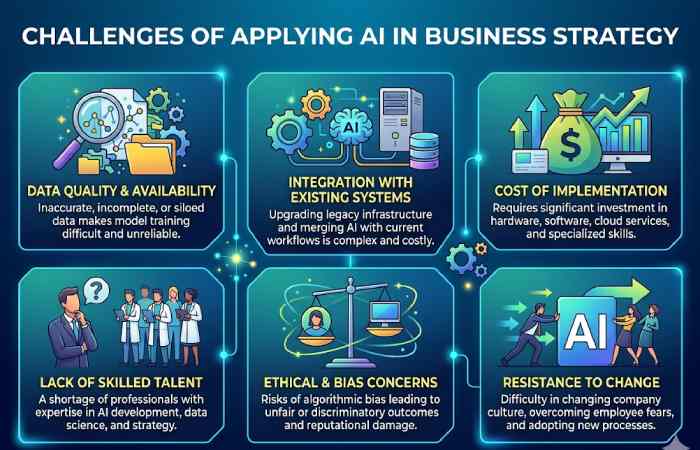
Despite its benefits, companies face several obstacles.
Data Quality Issues
AI systems require clean and structured data.
High Implementation Costs
Enterprise AI projects can cost $100K to $1M+.
Talent Shortage
There is a global shortage of:
-
- AI engineers
- data scientists
- machine learning specialists
Ethical Concerns
AI raises concerns about:
- algorithm bias
- privacy
- job displacement
AI Strategy vs Traditional Business Strategy
| Aspect | AI Strategy | Traditional Business Strategy |
| Decision Making | Data-driven decisions using machine learning, predictive analytics, and real-time insights | Decisions based on historical data, experience, and manual analysis |
| Speed of Analysis | Processes massive datasets instantly and delivers real-time insights | Analysis takes longer due to manual research and reporting |
| Data Utilization | Uses big data, structured and unstructured data from multiple sources | Primarily relies on structured internal data and reports |
| Automation | Automates repetitive tasks, forecasting, and operational decisions | Most processes require manual management and human intervention |
| Customer Insights | Advanced customer behavior prediction and personalization | Basic segmentation based on demographics and past purchases |
| Scalability | AI systems scale automatically with business growth and data expansion | Scaling requires additional staff, infrastructure, and resources |
| Predictive Capabilities | Uses predictive and prescriptive analytics to forecast trends and outcomes | Mostly reactive; strategies are adjusted after events occur |
| Operational Efficiency | Improves efficiency through automation, optimization algorithms, and smart systems | Efficiency improvements rely on process optimization and workforce productivity |
| Risk Management | AI models detect risks, fraud, and anomalies in real time | Risk analysis is periodic and depends on human monitoring |
| Cost Structure | High initial investment but lower long-term operational costs | Lower initial technology investment but higher ongoing operational costs |
| Innovation | Encourages continuous innovation through AI experimentation and automation | Innovation depends on human creativity and R&D cycles |
| Competitive Advantage | Provides faster adaptation to market changes and competitive intelligence | Competitive advantage depends on strategic planning cycles |
| Market Forecasting | AI predicts market demand, pricing trends, and customer needs | Forecasting relies on historical trends and analyst predictions |
| Implementation Complexity | Requires advanced infrastructure, skilled AI talent, and large datasets | Easier to implement using standard management practices |
| Adaptability | Continuously learns and improves using new data | Strategy changes occur periodically through management review |
Future Trends of AI in Business Strategy
Several trends will define the next decade of AI.
Generative AI in Strategic Planning
Tools like AI copilots will assist executives in scenario planning and forecasting.
Autonomous Business Systems
Companies will deploy AI systems capable of self-optimizing operations.
AI + Blockchain Integration
Combining AI with blockchain improves data transparency and security.
AI-Powered Digital Twins
Businesses will simulate operations using virtual AI models.
Conclusion
In standard terms, and as indicated by IBM, AI can learn from its experiences, find correlations, create hypotheses, remember the results, and learn from them, which would be beneficial for business in the digital age.