
 Kashifa Jafar
Technology Writer & Contributor
Kashifa Jafar is a technology writer and
contributor with 4+ years of experience
creating clear and reader-friendly
technology content.
Read Full Bio of Author →
Kashifa Jafar
Technology Writer & Contributor
Kashifa Jafar is a technology writer and
contributor with 4+ years of experience
creating clear and reader-friendly
technology content.
Read Full Bio of Author →
 Sameena Begum
Technology & Digital
Content Reviewer
Sameena Begum is a technology and digital content reviewer who reviews selected articles to help ensure that information is presented clearly, accurately, and responsibly.
Read Full Bio of Reviewer →
Sameena Begum
Technology & Digital
Content Reviewer
Sameena Begum is a technology and digital content reviewer who reviews selected articles to help ensure that information is presented clearly, accurately, and responsibly.
Read Full Bio of Reviewer →
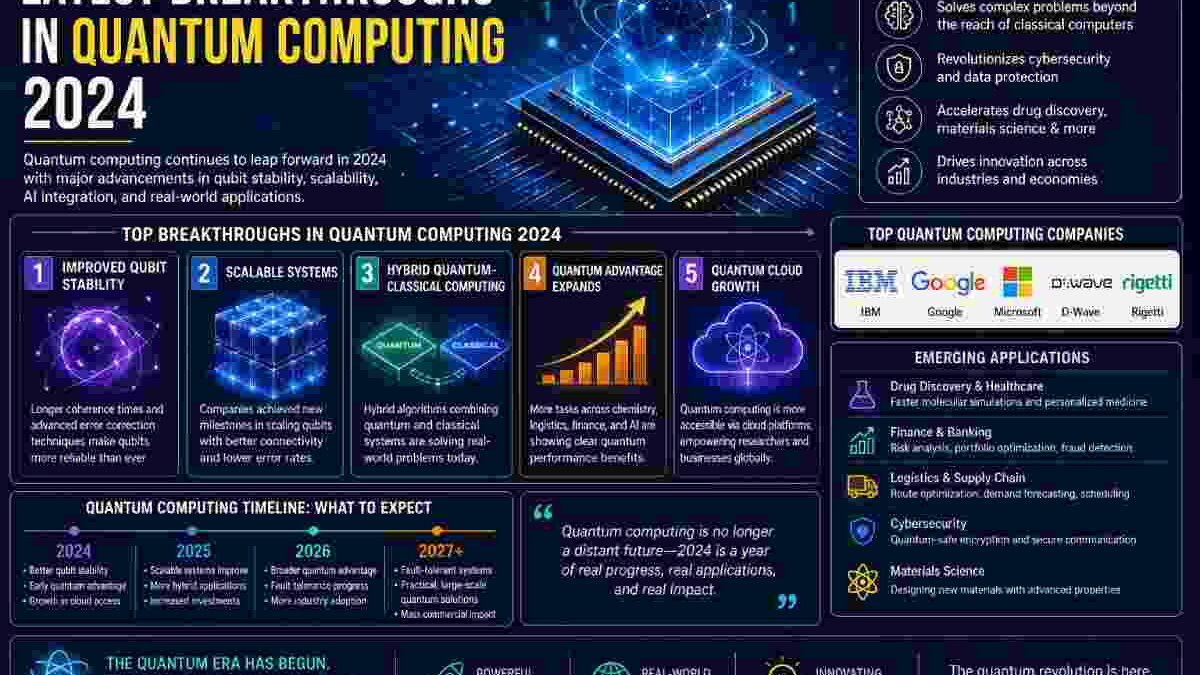
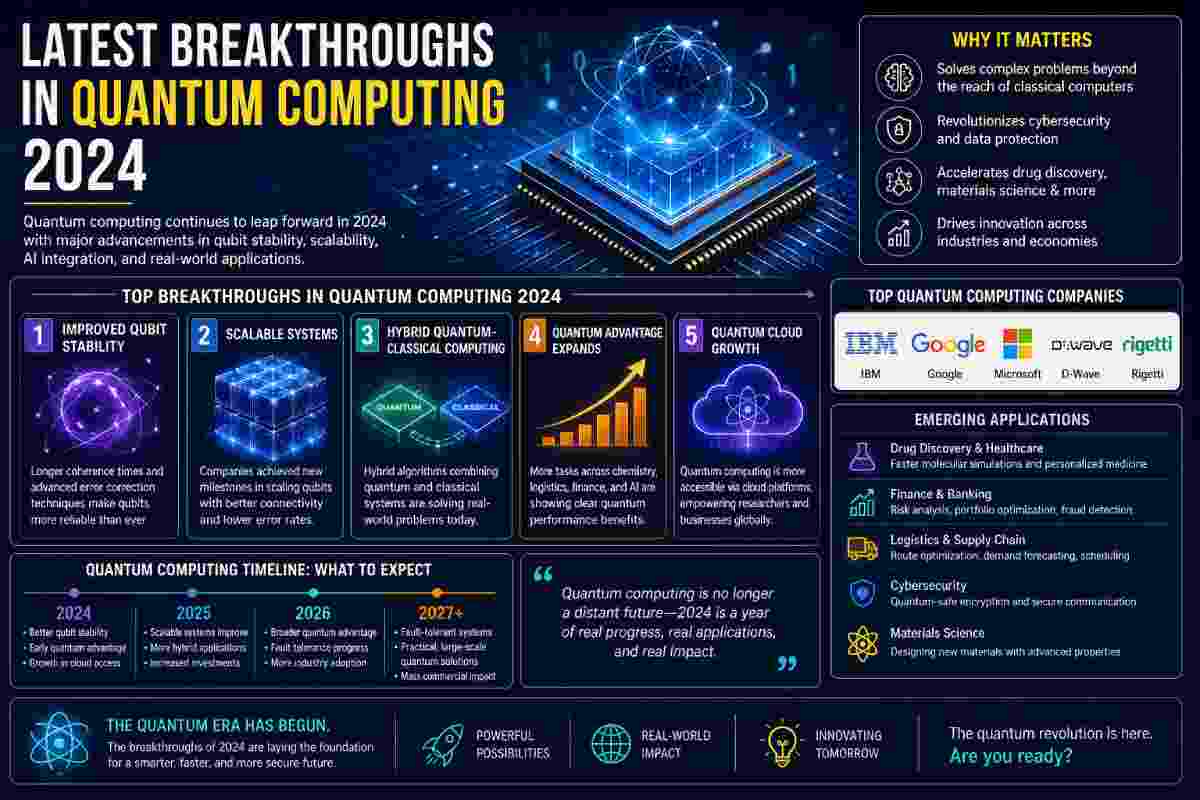
Latest Breakthroughs in Quantum Computing 2024 – Quantum computing, while less of a public darling than artificial intelligence these past few years, might have its time on center stage again soon. Only a couple of years ago the general scientific consensus was that quantum computing wouldn’t actually be able to do much useful for decades. That’s shortening as people demonstrate proof of concept quantum applications for tasks such as encryption or drug discovery.
“The last couple of years has been very, very exciting,” Scott Aaronson a computer scientist at the University of Texas at Austin told Discover. Through hardware, efficiency and demonstration of quantum advantage, computers that leverage the quantum properties are taking large steps forward.
Table of Contents
What Is Quantum Computing?
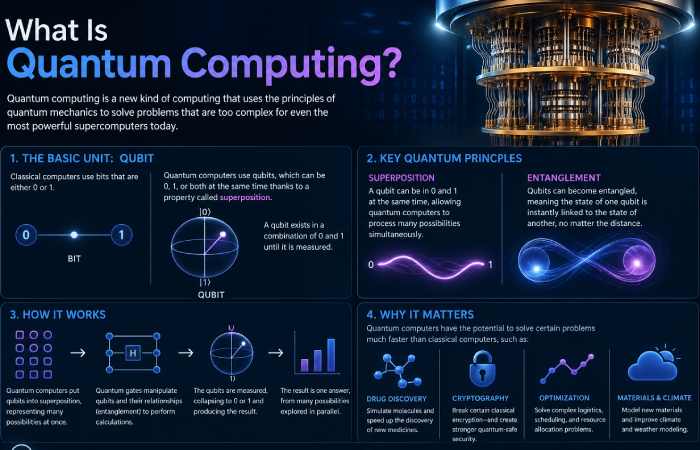
Quantum computing is a kind of computation which leverages concepts from quantum mechanics – a form of physics which governs small particles such as atoms – to perform computation in a radically different way than classical computation.
The Simple Idea
Classical computers like a laptop and a phone utilize what are called bits. Bits are the basic units of information in a classical computer, and can either be:
0, or 1
The quantum equivalent of a bit are called qubits (quantum bits) and can be either:
0, 1, or both at the same time, known as superposition.
Main concepts behind quantum computing:
- Superposition:
Because quantum bits can be put into many states at once, a quantum computer could check many possibilities simultaneously rather than over time.
- Entanglement:
Quantum bits can be chained together such that one qubit value cannot be determined without knowing the value of the other, even if there are kilometers of separation between them.
- Quantum Interference:
The potential to augment the correct calculation while also canceling out the inaccurate ones
Quantum computing is among the most significant emerging technology trends shaping the future, with the potential to transform industries ranging from healthcare to cybersecurity.
Latest Breakthroughs in Quantum Computing 2024
| Breakthrough | Description | Key Players | Impact |
| Improved Quantum Error Correction | Logic qubit development with decreased error rates and improved coherence times | IBM, Google | Enables more stable and scalable quantum systems |
| Scalable Quantum Hardware | Advancement toward 1000+ qubit processors and modular architectures | IBM, Rigetti | Moves quantum computing closer to commercial viability |
| Topological Qubits Research | Research into less erroneous, more error-resistant qubit types | Microsoft | Reduces dependency on heavy error correction |
| Hybrid Quantum-Classical Computing | Hybridization of quantum processors with classical processors | IBM, D-Wave | Practical real-world applications become feasible |
| Quantum Cloud Expansion | Broadened accessibility of quantum systems by cloud systems | IBM, Microsoft, Amazon | Democratizes access for developers and businesses |
| Early Quantum Advantage Demonstrations | quantum systems already outperforming classical computers for specific problems | Google, D-Wave | Validates real-world potential of quantum computing |
| Advances in Quantum Cryptography | QKD and quantum-safe encryption | Multiple research institutions | Strengthens future cybersecurity systems |
| Quantum AI Integration | application of quantum algorithms for improved AI/ML systems | Google, IBM | Faster and more efficient AI model training |
| Increased Commercial Investment | significant increased funding for both governmental and private institutions | Global tech companies | Accelerates innovation and ecosystem growth |
| Industry Standardization Efforts | normalization of standard tools, framework and APIs | IBM, Microsoft | Improves collaboration and adoption |
Quantum Hardware: Making Leaps
The process by which I attempt to solve the future of quantum computing focuses on a couple of categories and the first category being Hardware or rather the physical progression of a quantum computer. This represents the muscle-the qubit counts(high-speed cores), fidelity(accuracy), and coherency(musical timing of the qubits). It’s all about increasing the efficiency of the quantum processors. Here are my forecasts for quantum hardware:
Prioritizing Performance over count: Developers are expected to turn towards qubit quality/performance rather than quantity through 2025.
Pushing the boundaries in powerhouses: Power-focused countries and full-stack participants are expected to be invested heavily in pushing qubit counts until 2025, and will begin to increase resources devoted to qubit quality after that point.
As quantum computing advances, organizations are evaluating how it could impact encryption methods used in biometric technology and digital authentication systems worldwide.
Software: Composing the Music for Quantum Performance
Algorithms and Software. It is here where our quantum orchestra is instructed what tunes to play and our foray into application begins. For all of our super-powered processors are expensive paperweights without clean code.
Here are my two forecasts regarding Quantum Software:
Hybrid Quantum-Classical Applications: The real world applications for these hybrid algorithms are expected to enter the stage as early as 2025, and the potential for their success only increases after that.
Hybrid Algorithms Harmony: 2027 is when things are about to really heat up! Classical and quantum algorithms will more commonly be synthesized together to solve problems.
Researchers believe quantum-powered processing could significantly enhance augmented reality applications in modern computing by enabling faster data analysis and rendering.
Ecosystem Evolution
This category highlights the underlying infrastructure, relationships, and protocols that establish the playing field for our quantum results. Standardization and interoperability will largely drive how quantum technology is commercialized. All from the programmers to politicians must work hand in hand for quantum computing to succeed.
For this category, here are our predictions:
Huge Private Investment: Could we be seeing a quantum gold rush? Private companies may already become much more likely to explore and invest in quantum computing by 2025, leading to a flood of private funding that will propel the quantum race even faster.
Standardization Will Begin to Form: Common protocols and APIs requires consensus and partnership to develop, and this is process that we would predict will start to materialize by 2026.
The computational power of quantum systems may accelerate the development of the future of the metaverse ecosystem, supporting more immersive and scalable virtual environments.
Why is Quantum Computing Gaining Traction?
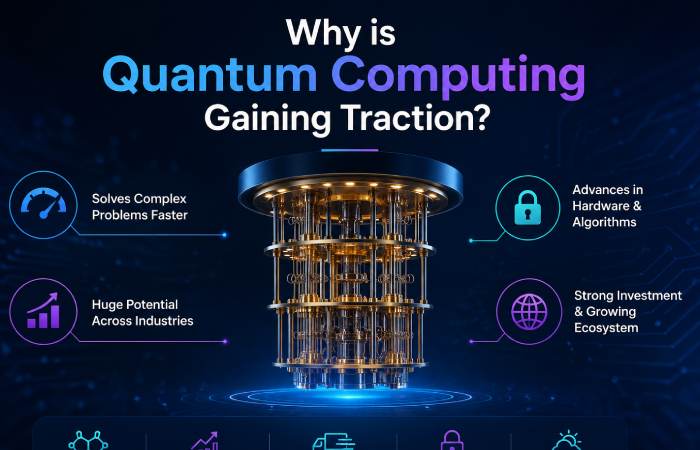
Below we discuss some applications where quantum computing is set to bring massive changes due to solving problems much more quickly:
- Cryptography and Security:
The quantum computing will undoubtedly impact the security landscape, though it has the potential to also lead to new quantum-safe encryption algorithms that are far more secure. This will make the field of quantum key distribution (QKD), a quantum phenomenon for secure communication and data, ever more important.
- Artificial Intelligence (AI) and Machine Learning (ML):
It is expected that AI and ML will benefit from exponential improvements, harnessing quantum computer power to speed up training times, improve accuracy and increase data analysis capability. Quantum-accelerated algorithms can execute complex jobs in fields such as healthcare, finance, and logistics that are beyond the capabilities of conventional computing.
- Drug Discovery and Healthcare:
By performing detailed simulations of molecular structure, quantum computing can speed up drug development and offer the possibility of individualized treatment. Quantum simulations can facilitate analysis of such critical steps in drug discovery as protein folding.
- Optimization Problems:
Because of their inherent aptitude at solving complex, large-scale optimization problems, quantum computers may find use in supply chains, logistics, manufacturing, and financial systems; they are applicable to problems including portfolio and route optimization.
Combined with how 5G technology enables next-generation innovations, quantum computing could help power real-time analytics and intelligent connected devices.
Top Quantum Computing Companies
| Company | Focus Area | Quantum Hardware | Pricing / Access | Resource Link |
| IBM | Superconducting qubits | IBM Quantum Systems | Free tier + enterprise pricing | https://quantum.ibm.com |
| Quantum supremacy research | Sycamore processor | Not publicly priced | https://quantumai.google | |
| Microsoft | Topological qubits + Azure Quantum | Cloud-based | Pay-as-you-go (Azure) | https://azure.microsoft.com/quantum |
| D-Wave | Quantum annealing | Advantage system | Subscription-based | https://www.dwavesys.com |
| Rigetti Computing | Hybrid quantum systems | Superconducting processors | Cloud pricing | https://www.rigetti.com |
Quantum Advantage and Beyond
To what degree will quantum computers offer a performance improvement over classical computers for particular applications? This is the category that investigates that eagerly awaited day when a task will be possible via quantum computer where it previously was not via classical computation.
My predictions about the quantum advantage:
Early Quantum Advantage glimpses: I estimate that we could begin to see hints of quantum computers outperforming classical computers for some specific tasks by 2025 with moderate increase in probability of that happening by 2026.
Fault Tolerance takes off: Building fault-tolerant quantum computers is going to take a while, it is a long race and not a sprint. The earliest that fault tolerant quantum computer applications may be emerging are by 2027.
Wider Quantum Advantage applications to arise: This is the main goal-diverse applications beginning to be tackled via quantum computation will start to occur. Initially this could be slow and increase by 2027.
Quantum usefulness is achieved: To actually achieve solving problems using quantum computation commercially will take some time until late 2020’s to early 2030’s. If it takes that long then it should provide a large improvement.
Financial institutions are exploring how quantum computing could strengthen identity verification processes used in eKYC biometric verification solutions.
Summing Things Up
| Trend / Prediction | 2024 | 2025 | 2026 | 2027+ |
| Quality over Quantity: Prioritize qubit fidelity and coherence over QPU size | Low | Mid | Very Low | Very Low |
| Standardization Taking Hold: Establish universal protocols and APIs | Very Low | Low | Mid | Very Low |
| Powerhouse Regions Boost Scale: Several areas focus on scaling the number of qubits | Mid | Mid | Very Low | Very Low |
| Initial quantum advantage appears: demonstrable improvements in certain tasks | Very Low | Low | Mid | Very Low |
| The wider reach of quantum advantage emerges: extend to many other problem domains | Very Low | Very Low | Low | Mid |
| Commercial funding expands significantly: grow investment from private sectors | Low | Mid | Low | Very Low |
| Classical and quantum harmonize: combine forces via algorithms | Very Low | Low | Mid | Very Low |
| First hybrid classical and quantum applications emerge: use practical scenarios | Very Low | Very Low | Low | High |
| Fault tolerant approaches gain momentum: error resistance enhances system performance | Very Low | Very Low | Low | High |
| Commercial value from quantum begins to show: commercially relevant problems remain addressed | Very Low | Very Low | Low | Very High |
Back to the (Quantum) Future
These categories might remain considered a “map to the future of quantum computing”. Naturally I do not have a crystal ball and the future cannot be known; there will remain challenges and twists but by concentrating on these key areas, a view of the nearer future may be formulated.
The hardware remain likely to mature with emphasis placed on quality and bigger and better processors; standardization will facilitate interoperability and, as the potential benefits of quantum solutions can no longer remain disputed, investment might increase drastically.
Quantum Computing Advancements in 2024
| Advancement | Description | Impact |
| Improved Qubit Stability | Extended coherence times and better error correction | Better Quantum Operations |
| Quantum Cloud Computing | Increased access to quantum resources in the cloud | Access to Quantum Technology for all |
| Quantum AI | Better AI models using quantum neural networks | Faster and more precise AI answers |
| Advancement in Quantum Cryptography | Better QKD and quantum-safe encryption protocols | Greater Data Safety |
| Hybrid Quantum-Classical Systems | Merging quantum and classical computing | Applications on a wide variety of fields |
IBM Quantum and Amazon Braket offer insights into quantum cloud services, you can know more through the links.
What’s Next for Quantum Computing in 2024?
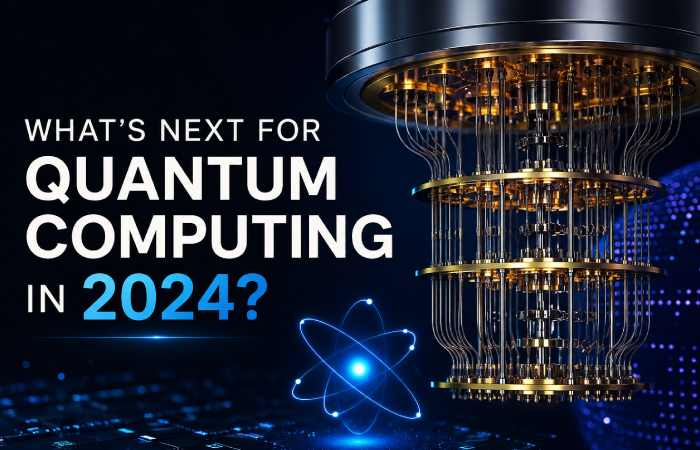
The quantum computing landscape in 2024 is expected to evolve with significant breakthroughs:
- Practical applications across industries such as finance, healthcare, logistics, and cybersecurity.
- Improved accessibility through quantum cloud platforms and open-source tools.
- Stronger collaboration between academia, tech giants, and governments to push quantum research and applications further.
- Regulatory frameworks that address the ethical, privacy, and security implications of quantum computing.
Key Predictions for 2024
| Prediction | Details |
| Widespread Quantum Cloud Adoption | More businesses adopt quantum cloud services. |
| Enhanced AI with QNNs | Quantum neural network may make AI models more efficient. |
| Increased Investment | Increase in investment on R&D, hardware development, education. |
| Regulatory Focus | A new frameworks to address the risk management and ethical issue of quantum technologies. |
Conclusion
Quantum computing is about to make every industry significantly more efficient. Even though we are in the very early stages of large scale quantum computing, progress expected in 2024 brings us closer to our vision for how we’ll benefit from it.
By powering up the efficiency of AI and logistics, through providing ultimate security for data with quantum-safe cryptography, there is no telling what else this technology may do. Overcoming issues with error rates, scale, and the current lack of a quantum computing skill set will be essential in order to realize the full potential of the technology.
Keep up for more updates, as the quantum supremacy race unfolds!
Read more on quantum computing advances that can remain expected in 2024:
- Google Quantum AI
- IBM Quantum Computing
- Microsoft Azure Quantum
Frequently Asked Questions Section
What are the newest advancements in quantum computing 2024?
Key advances include enhanced error correction, scalable qubit frameworks, and the fusion of quantum-classical computing models.
Is quantum computing commercially available 2024?
Yes, largely on the cloud platforms of players like IBM and Microsoft as opposed to standalone hardware.
Who are the key players in quantum computing?
The industry leaders are IBM, Google, Microsoft, D-Wave and Rigetti.
When will quantum computers replace classical computers?
They will augment and not entirely replace classical machines.
Is quantum computing relevant in India?
Yes, India remain heavily invested and strong on opportunities from R&D to software to talent building.
Kashifa Jafar is a technology writer and contributor with 4+ years of experience covering AI, cloud computing, mobile technology, software, networking, cybersecurity, and emerging technology.
View Author Profile →
Sameena Begum is a technology and digital content reviewer who reviews selected articles to help ensure that information is presented clearly, accurately, and responsibly.
View Reviewer Profile →