


It’s not every day that you see “vuraiyaasmaa tidalharb” trending among online users, especially those who are inclined to digital culture, internet slang and up-coming searches. Mainstream expressions do have its authorities in the internet while this word is hardly anything with an accepted reference. This makes it not just unique but hard to define.
Here in this article, we will discuss the various meanings, understandings and background of the expression and how certain weird searches tend to go viral.
Table of Contents
What Is Vuraiyaasmaa Tidalharb?

A commonly cited definition of vuraiyaasmaa tidalharb has not been established in any recognized dictionary, academic resource or reference database, searches on engine for this keyword fail to yield a relevant explanation of it and results display nothing more than fragments or unrelated references.
From these indications it can be concluded that the keyword may fit one of the following classifications.
| Possible Interpretation | Explanation |
| Fictional Name | Might be a fantasy character, from a game, novel, or artwork. |
| Username or Alias | Might be an online username, or the name of a digital creator. |
| Experimental SEO Keyword | Might be used to test SEO, or for analysis of AI-generated text. |
| Emerging Trend | Might be a newly-coined internet slang term that is spreading. |
| Encrypted/Modified Phrase | Might feature modified spelling. |
Due to the lack of consistent definition, the search intent seems to be mostly informative and exploratory.
Origins And Interpretive Context
It seems likely that this was an ad hoc coinage rather than a formal linguistic construct. In most cases, the words are divided into two main concepts. When thinking of “Vuraiyaasmaa,” we’re often referring to perception, awareness or a consciousness that is being monitored. “Tidalharb”, then, refers to an activity, action, or response, triggered by the process of change.
The two words put together then mean something akin to: “We perceived something, therefore we act.” This structure of “perceive/then act” is reminiscent of the modern framework used in decision science, behavioral psychology and adaptive management methods. Because the word does not appear to have a fixed, specific definition, it can be applied in numerous fields of inquiry, from environmental science to productivity.
Conceptual Framework And Core Meaning
Vuraiyaasmaa Tidalharb shows a nice example of an adaptive and improving system using observation, adaptation, and synchronized action. It is generally considered a way to make people responsive to the patterns of nature or system dynamics rather than imposing rule sets that forbid deviation from a certain way of doing things.
This sort of framework is generally comprised of three parts. The first, observation, is intended to notice patterns or shifts in the system. Second, calibration adjusts what’s being done based on what patterns or changes were observed. Third, synchronized action completes the loop by acting at the optimal times to gain both maximum speed and balance.
Essentially the framework is one that encourages reaction rather than the creation of stimuli, and agreement rather than conflict. This sort of framework helps people be resilient and sustainable in many challenging situations where there is a constant rate of change.
Scientific And Environmental Interpretations
| Aspect | Scientific & Environmental Interpretation of “Vuraiyaasmaa Tidalharb” |
| Core Meaning | Describes fluctuations in tides which are erratic but predictable and their impact on the coastal and marine realm on a longer timescale. |
| Main Focus | Understanding how shifting tidal dynamics impact on coastlines, ecosystems and built structures. |
| Tidal Movement | Looks at changing flow patterns, wave patterns and changing sea level in the coastal area. |
| Sediment Flow Impact | Long-term trends in tidal movements may change the balance between erosion and accretion along coastlines. |
| Marine Habitat Effects | The changes in the nature of tidal phenomena might be detrimental to coral reefs, mangroves, fish nurseries and other habitats. |
| Shoreline Stability | Changes to the nature of tides might be negative for structural integrity and encourage erosion and flooding. |
| Climate Change Connection | Aids in climate change adaptation planning as sea level trends and environmental changes are recorded. |
| Research Methods | Scientists evaluate factors such as tidal cycles, water levels, salinity, marine flora and fauna, the ecosystem’s reaction. |
| Environmental Planning Role | Helps develop adaptation planning for coastal defense and sustainable coastal management. |
| Infrastructure Influence | Design plans for ports, seawalls, drainage systems and buildings in the coastal zones will accommodate future changes. |
| Ecological Benefits | Protective measures designed around natural tidal patterns are less likely to damage the environment and the animal communities living in it. |
| Economic Advantages | Sustainable development plans using natural systems and long-term monitoring may minimize expenditure in repair or disaster relief. |
Systems Thinking And Adaptive Management
Generally speaking, people discuss this concept in the framework of a dynamic system model which can be applied to improving processes across many domains, not just environmental science. The point of thinking this way is to encourage people to operate in cycles, rather than linear schedules.
This is quite applicable to areas such as infrastructure design, resource management, and even implementing automated systems in digital terms. For example, it could help an energy system align its output with consumer demand so as to more evenly distribute that demand and avoid large peaks. Resource management systems for water might benefit by operating according to precipitation patterns.
The best thing about this type of approach is that it provides foresight. Rather than attempting to react after something has already occurred, adaptive calibration can help systems anticipate the future and respond proactively.
Psychological And Behavioral Dimensions
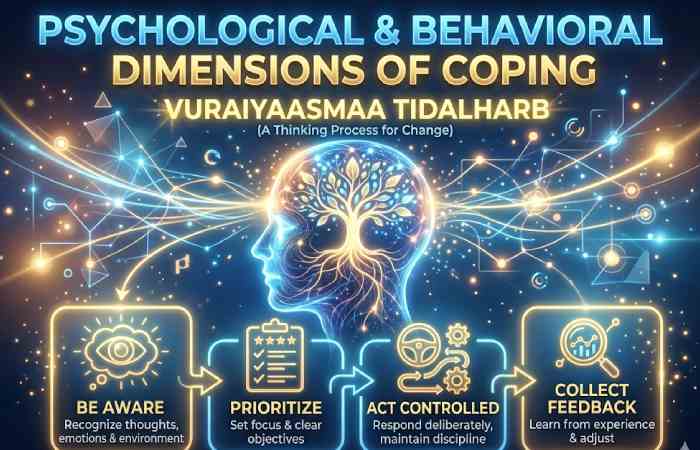
Many also say that vuraiyaasmaa tidalharb is a thinking process that you can use to cope with difficult times and changes. In this case, you learn to be aware of things, establish priorities, act in a controlled manner, and collect feedback continuously.
The whole approach begins by individuals understanding the current situation and encourages them to view the realities without any biases. After this it goes on to talk about setting goals, performing small tasks, checking the outcome and following it continuously with discipline.
This behavioural loop increases people’s resilience by enabling them to resist the urge to act without forethought. Individuals can get out of being trapped or respond erratically to the chaos by joining awareness with action.
Practical Steps For Applying The Framework
| Practical Step | Explanation | Real-Life Benefit |
| Seeing Clearly | Accurate understanding of present without judgment and assumptions; | Allows individuals and organizations to move confidently and wisely toward goals. |
| Defining Priorities | Prioritizing the biggest results and putting energy in places that will truly create desired effect; | Helps focus and prevent distractions during unstable and transitional times. |
| Taking Direct Action | Taking first few tiny, instant, and workable actions rather than overthinking; | Generates momentum, confidence and enables faster attainment of goals. |
| Building Feedback Loops | Reviewing the results periodically and learning from the successes and mistakes; | Enables good future decisions and helps avoid past mistakes. |
| Maintaining Discipline | Being consistent to plans, habits and big goals even through difficulties; | Establishes a foundation for stability, robustness and durable progress. |
| Encouraging Adaptability | Being adaptable to change and flexible when the situation demands a different approach; | Enables both individuals and systems to adapt efficiently to emerging situations. |
| Supporting Continuous Improvement | Incremental improvements derived from observing and experimenting; | Contributes to enhanced effectiveness and more robust systems. |
| Balancing Stability and Change | Planning and having a structure while maintaining adaptability. | Creates stable, sustainable progress without losing control during the change process. |
Digital Culture And Emerging Popularity
It is starting to appear on more and more sites such as newsgroups, blogs etc. It is a concept meme that gains attention due to it is very open to interpretation and is mystifying to those that read about it. Vuraiyaasmaa Tidalharb is often used when discussing the varied meanings of things and how they may be used in a learning environment, to understand the environment around us or to be used to make online systems work.
Concepts of the blend of science, psychology and symbolism are being discussed on many areas of the internet. Many of these words become very popular and allow academics to explore issues such as science, psychology and symbolism from different areas.
Comparison of Vuraiyaasmaa Tidalharb
| Framework Principle | Purpose | Practical Example | Main Benefit | Helpful Resource |
| Seeing Clearly | Be aware of present circumstances with clarity and without ambiguity. | Researchers studying tide data in a coastal area before designing the coastline protection measure. | Making better choices and fewer mistakes | NOAA Tides & Currents |
| Defining Priorities | Prioritize the most crucial objectives and results. | Flood potential areas in the coast being favored over less exposed areas by planners. | Enhances efficiency and effective resource management | UN Sustainable Development Goals |
| Taking Direct Action | Start with immediate, incremental, and manageable actions. | Temporary barriers put in place before undertaking massive coastal project. | Creates forward momentum and avoided delays | World Bank Climate Adaptation Resources |
| Building Feedback Loops | Observe and evaluate results and amend actions. | Researchers identify patterns of erosion on the coast on an annual basis and revise designs. | Supports constant improvement and less repeated errors | NASA Earth Observatory |
| Maintaining Discipline | Adhere to long-range objectives and monitoring systems. | While there may not be immediate threats, governments still carry out environmental assessments. | Fosters lasting resilience and sustainable growth | UN Environment Programme |
| Encouraging Adaptability | Modify tactics when conditions-socially or ecologically-shift. | Coastal cities redesign systems once they hear sea levels will be higher than expected. | System performance in uncertain environments remains sound | IPCC Climate Change Reports |
| Supporting Continuous Improvement | Imrove systems and responses using recorded information and observations. | Scientists enhance conservation techniques as they learn how the ecosystem responds. | Leads to robust strategies for environment protection | National Geographic Environment |
| Balancing Stability and Change | Integrate rigid plans with adjustable mechanisms of reaction. | The coastal management agency keeps current seawalls maintained while considering nature-based solutions. | Promotes balance and sustainable development | OECD Environment Directorate |
Benefits And Advantages

There is an increased interest in Vuraiyaasmaa tidalharb because people think that it will benefit them. It enhances adaptive resilience by ensuring that reaction is in line with the way it is changing. Doing things at a proper time synchronised with some natural or systemic cycle makes things efficient.
It enhances environmental conditions by judicious use of resources and minimizing waste generation. Psychologically it reduces stress by transforming response behavior and organizationally long- term preparedness.
Conclusion
The idea of Vuraiyaasmaa tidalharb is very multi-disciplinary, including work from environmental science, system thinking, behavioral resilience and symbols analysis. Fundamentally the principle is the same, regardless of whether you view Vuraiyaasmaa tidalharb as a framework for adaptive management, an approach to adapting to change or a model for transforming things, “Awareness leading to action”.