


In today’s digital-first world, the way people buy has changed dramatically. Traditional sales tactics like cold calling and direct pitching are becoming less effective, as modern consumers prefer to research, engage, and build trust before making a purchase decision. This shift has given rise to a more relationship-driven approach known as social selling.
Social selling is not about pushing products—it is about creating meaningful connections through social media platforms, providing value, and positioning yourself as a trusted resource. Whether you are a business owner, marketer, or sales professional, leveraging social platforms like LinkedIn, Instagram, and Facebook can help you attract the right audience and convert them into loyal customers.
In this guide, you will learn how social selling works, why it matters, and how to implement proven strategies to turn your social media presence into a powerful lead-generation and sales engine.
Table of Contents
What is Social Selling?
Social selling is a modern sales approach that uses social media platforms to identify prospects, build relationships, and convert them into customers over time. Instead of relying on cold calls or direct advertising, it focuses on engaging with potential buyers through valuable content, meaningful conversations, and consistent interaction.
At its core, social selling is about trust-building rather than hard selling. Businesses and individuals connect with their target audience on platforms like LinkedIn, Instagram, Facebook, and X (formerly Twitter), offering insights, answering questions, and sharing relevant content that addresses real problems.
Simple Definition
Social selling is the process of using social networks to find, connect, engage, and nurture prospects until they are ready to make a purchase.
Key Elements of Social Selling
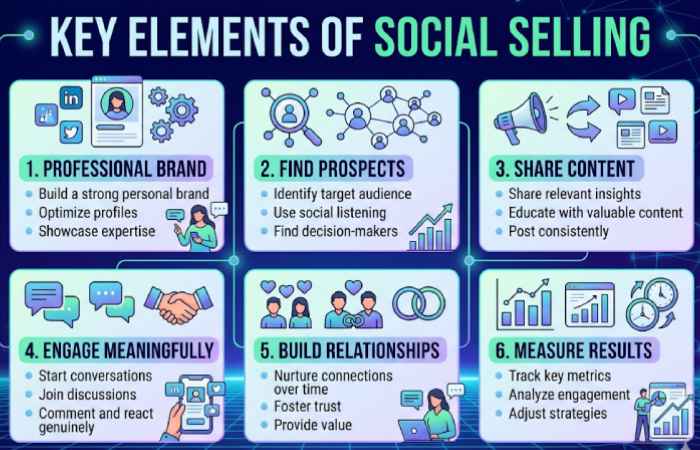
- Profile Optimization
Your social media profile acts as your digital identity and first impression. - Content Creation
Sharing valuable, educational, or engaging content to attract and inform your audience. - Engagement
Interacting with users through comments, messages, and discussions. - Relationship Building
Developing long-term trust instead of focusing on quick sales. - Soft Selling
Recommending solutions naturally rather than pushing products aggressively.
Why Social Selling Matters
| Factor | Traditional Selling | Social Selling |
| Trust Level | Low | High |
| Conversion Rate | Moderate | Higher |
| Cost | Expensive | Cost-effective |
| Relationship Building | Limited | Strong |
| Scalability | Restricted | High |
Modern consumers prefer to research and trust a brand before making a purchase. Social selling aligns perfectly with this behavior.
How Social Selling Works: Step-by-Step Framework
- Optimize Your Profile
Your profile acts as your digital storefront. Ensure:
- A professional image
- A clear value proposition
- A strong call-to-action
- Define Your Target Audience
- Identify your niche
- Understand customer pain points
- Track where your audience spends time
- Create Value-Driven Content
Effective content includes:
- Educational posts
- Problem-solving insights
- Case studies
- Personal experiences
- Engage Consistently
- Respond to comments
- Start conversations
- Interact with your audience’s content
- Build Relationships First
- Avoid early sales pitches
- Focus on providing value
- Establish trust before selling
- Convert Through Value
- Offer solutions instead of pushing products
- Use consultation-based conversations
- Share testimonials and success stories
The Psychology Behind Social Selling

Social selling works because it leverages key psychological principles:
- Reciprocity: Providing value encourages users to respond
- Authority: Consistent content builds credibility
- Familiarity: Repeated exposure increases trust
- Trust: Long-term engagement reduces buying resistance
Proven Social Selling Strategies
| Strategy | Description | Impact |
| Personal Branding | Establish a strong identity | Builds trust |
| Storytelling | Share relatable narratives | Creates emotional connection |
| Micro-Content | Short, valuable posts | Improves reach |
| Social Proof | Testimonials and reviews | Increases conversions |
| Consistency | Regular posting | Strengthens visibility |
Best Platforms for Social Selling
| Platform | Best For | Key Features | Pricing | Resource Link |
| LinkedIn Sales Navigator | B2B Sales & Lead Generation | Advanced lead search, InMail messaging, CRM integration | Starts at approx. ₹8,900/month ($119.99/month) | View Pricing |
| Personal Branding & Influencer Sales | Stories, Reels, DMs, shopping features | Free (Ads optional) | https://business.instagram.com | |
| Community Building & Local Business | Groups, Marketplace, Ads targeting | Free (Ads optional) | https://www.facebook.com/business | |
| X (Twitter) | Thought Leadership & Real-Time Engagement | Threads, trends, direct messaging | Free (Premium optional) | https://business.x.com |
| Hootsuite | Social Media Management & Automation | Scheduling, analytics, multi-platform management | Starts at $99/month | https://www.hootsuite.com |
| Zoho Social | Small Businesses & Agencies | Scheduling, CRM integration, analytics | Free plan available; paid starts at $10/month | https://www.zoho.com/social |
| HubSpot | Integrated Sales & Marketing | CRM, email tracking, automation | Free plan; paid starts ~$20/month | https://www.hubspot.com |
Social Selling Message Templates
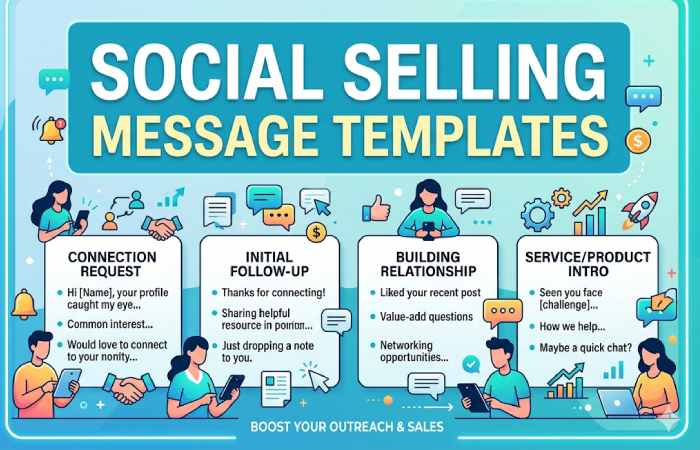
First Connection Message
“Hello [Name], I came across your profile and found your insights on [topic] valuable. I would like to connect.”
Value-Based Follow-Up
“I noticed you are working on [problem]. I recently shared some ideas on this topic. Let me know if you would like me to share them.”
Soft Conversion Message
“If you are interested, I can suggest a few strategies that may help you achieve [goal]. No obligation.”
Top Social Selling Tools to Automate and Scale
| Tool | Best For | Key Features | Pricing (Approx.) | Resource Link |
| Hootsuite | Multi-platform management & automation | Post scheduling, social listening, analytics, AI content tools | Starts at $99/month | https://www.hootsuite.com |
| Buffer | Affordable scheduling & automation | Content scheduling, analytics, engagement tools | Free plan; paid from $5–$12/channel/month | https://buffer.com |
| Sprout Social | Advanced analytics & enterprise scaling | Social CRM, reporting, automation, sentiment analysis | Starts at $199/user/month | https://sproutsocial.com |
| Zoho Social | Small businesses & CRM integration | Scheduling, monitoring, CRM integration, analytics | Free plan; paid from $10/month | https://www.zoho.com/social |
| HubSpot | All-in-one marketing + sales automation | CRM, email tracking, social scheduling, automation workflows | Free plan; paid from ~$20/month | https://www.hubspot.com |
| Later | Visual content planning (Instagram-first) | Drag-and-drop calendar, media library, scheduling | Free plan; paid from $25/month | https://later.com |
| Agorapulse | Agencies & team collaboration | Unified inbox, reporting, automation, AI tools | Starts at ~$79/user/month | https://www.agorapulse.com |
How to Build a Personal Brand for Social Selling
Building a strong personal brand is the foundation of successful social selling. People do not buy from profiles—they buy from trusted individuals. A well-crafted personal brand helps you stand out, build credibility, and attract the right audience organically.
Define Your Niche and Target Audience
Start by getting clear on:
- Who you want to reach
- What problems you solve
- What value you provide
Avoid being too broad. A focused niche makes it easier to position yourself as an expert and attract the right prospects.
Craft a Clear Value Proposition
Your audience should immediately understand:
- What you do
- Who you help
- What results you deliver
Example:
“I help small business owners generate leads using social selling strategies.”
Keep it simple, specific, and outcome-driven.
Optimize Your Social Profiles
Your profile is your digital first impression. Ensure it includes:
- Professional profile photo
- Compelling headline or bio
- Clear description of your expertise
- Call-to-action (CTA), such as booking a call or sending a message
Think of your profile as a landing page designed to convert visitors into connections.
Create Consistent, Value-Driven Content
Content is how you demonstrate expertise and build trust.
Types of Content to Post:
- Educational tips and insights
- Industry trends and updates
- Personal experiences and lessons
- Case studies and results
- Problem-solving posts
Content Tips:
- Focus on your audience’s pain points
- Keep posts simple and actionable
- Maintain a consistent posting schedule
Develop a Unique Voice and Style
Your personal brand should feel authentic and recognizable.
- Write in a consistent tone (professional, conversational, etc.)
- Share your opinions and perspectives
- Use storytelling to connect emotionally
Authenticity builds stronger connections than perfection.
Engage With Your Audience Daily
Social selling is not just about posting—it is about interaction.
- Respond to comments
- Engage with others’ posts
- Start conversations in direct messages
- Ask questions to encourage discussion
Consistent engagement increases visibility and builds relationships.
Build Authority and Credibility
Position yourself as a trusted expert by:
- Sharing insights and expertise regularly
- Providing solutions to common problems
- Collaborating with others in your industry
- Showcasing testimonials and results
Over time, this builds trust and influence.
Social Selling vs Digital Marketing:
| Aspect | Social Selling | Digital Marketing |
| Primary Goal | Build relationships and trust | Generate traffic, leads, and conversions |
| Approach | One-on-one engagement | One-to-many communication |
| Communication Style | Personalized and conversational | Campaign-based and structured |
| Channels | Social media platforms | SEO, PPC, email, social media, websites |
| Focus | Long-term relationships | Short-term and long-term results |
| Sales Process | Indirect and gradual | Direct or funnel-driven |
| Trust Building | High priority | Secondary (depends on strategy) |
| Content Type | Personal, value-driven | Promotional, informational, branded |
| Measurement | Engagement, conversations, relationships | Traffic, CTR, conversions, ROI |
Common Mistakes to Avoid
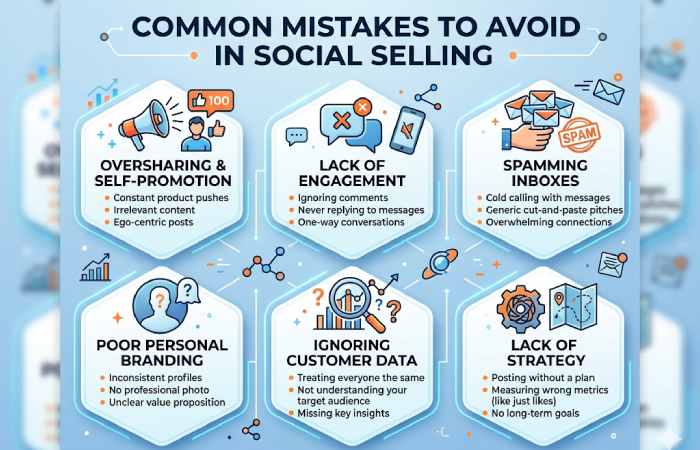
- Pitching too early
- Being overly promotional
- Ignoring audience engagement
- Posting inconsistently
- Not understanding the target audience
Social Selling ROI
Businesses that implement social selling effectively often experience:
- Increased lead generation
- Higher conversion rates
- Improved customer retention
- Stronger brand authority
Final Thoughts
Social selling has become a core strategy in modern marketing. It focuses on trust, consistency, and value rather than direct selling. Businesses that invest in relationship-building and meaningful engagement are more likely to achieve long-term success.