
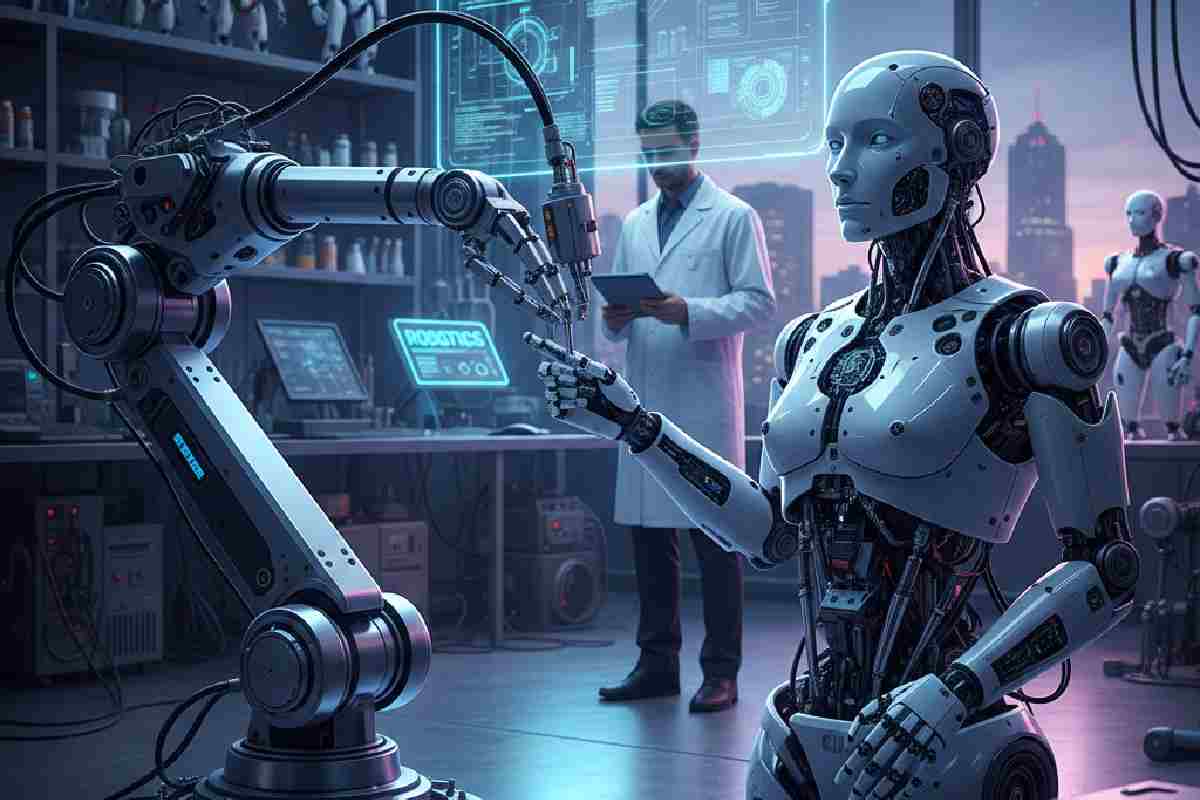
We define a robot as an automaton entity composed of artificial mechanics and an electromechanical system. It has been created from the research of science and technology. A robot differs from a bot in that it comprises physical and tangible mechanisms, while the bot is hosted in software within a virtual system located in the Cloud.
Table of Contents
What Is Robotics?
Robotics is a branch of science and engineering that focuses on designing, building, programming, and operating robots — machines that can perform tasks automatically or semi-automatically.
It combines multiple disciplines, including:
- Mechanical Engineering
- Electrical Engineering
- Computer Science
- Artificial Intelligence (AI)
- Electronics
Simple Definition
Robotics is the field of technology that deals with creating intelligent machines that can assist or replace humans in performing tasks.
Key Components of Robotics
| Component | Purpose |
| Sensors | Detect environment (temperature, light, distance, motion) |
| Actuators | Create movement (motors, hydraulics, pneumatics) |
| Controller | The robot’s “brain” that processes information |
| Power Supply | Provides energy (battery, electricity) |
| Software/AI | Enables decision-making and automation |
History of Robots & Early Automata
| Time Period | Inventor / Civilization | Innovation / Automaton | Description & Significance |
Ancient Greece (c. 400 BCE) |
Archytas of Tarentum | Mechanical Pigeon | A steam-powered wooden bird that could fly briefly — considered one of the earliest recorded automata. |
Ancient Greece (c. 1st Century CE) |
Hero (Heron) of Alexandria | Mechanical Theaters & Automatic Doors | Designed programmable mechanical devices using water, steam, and pulleys. Early foundation of automation. |
Ancient China (c. 3rd Century BCE) |
Yan Shi (Legend) | Humanoid Automaton | Ancient texts describe a life-sized mechanical human presented to King Mu — early concept of humanoid robots. |
Islamic Golden Age (1206 CE) |
Al-Jazari | Programmable Musical Automata | Built water-powered robots, including a programmable band of musicians — early programmable machines. |
Renaissance (1495) |
Leonardo da Vinci | Mechanical Knight | Designed a humanoid knight capable of sitting, standing, and moving arms. Early robotics blueprint. |
18th Century (1738) |
Jacques de Vaucanson | Digesting Duck | Mechanical duck that could flap wings and simulate digestion — showcased advanced mechanical automation. |
18th Century (1770) |
Wolfgang von Kempelen | The “Mechanical Turk” | Chess-playing machine (later revealed as a hoax). Popularized idea of intelligent machines. |
19th Century (1801) |
Joseph Marie Jacquard | Jacquard Loom | Used punched cards to automate weaving — foundation for programmable machines and early computing. |
1921 |
Karel Čapek | Term “Robot” (R.U.R. Play) | Introduced the word “robot” from the Czech word robota (forced labor). Defined cultural idea of robots. |
1940s–1950s |
Isaac Asimov | Three Laws of Robotics | Defined ethical framework for robots in science fiction, influencing modern robotics ethics. |
1954 |
George Devol | Unimate (First Industrial Robot) | First programmable robotic arm; installed in a GM factory in 1961 — start of industrial robotics era. |
1960s–1970s |
Various Researchers | Mobile & AI Robots | Development of robots with sensors and basic AI capabilities. |
1990s |
Honda | ASIMO | Advanced humanoid robot capable of walking and interacting — milestone in humanoid robotics. |
2000s–Present |
Global Tech Companies | AI-Powered & Autonomous Robots | Robotics integrated with AI, machine learning, and IoT; used in healthcare, logistics, defense, and space exploration. |
Who Invented Industrial Robotics?
The inventor of the first industrial robot was George Charles Devol, which is why he is considered the inventor of robotics and the creator of the first robots. Born in Kentucky in 1912, George Devol is an American inventor who distinguished himself early on through his intelligence.
Together with Joseph F. Engelberger, Devol founded Unimation, a company dedicated exclusively to developing the first industrial robots.
George Devol developed the first programmable machine in the past in 1948 and was notable for its ease of use and adaptability. This should be the basis for developing programmable robots, which he later produced with Joseph Engelberger in his robotics shop.
The Three Laws of Robotics
Later, Isaac Asimov defined robotics as the science responsible for studying and developing robots. He invents the “Three Laws of Robotics” for his science fiction novels, which can be summarized as follows:
- A robot cannot harm a human.
- A robot must follow a human’s instructions as long as it does not harm another human.
- A robot necessity ensures its existence as long as it does not contradict the first and second laws.
Types of Robots
| Type of Robot | Description | Key Features | Common Applications |
| Industrial Robots | Robotic arms used in manufacturing and production | High precision, repetitive motion, heavy-duty | Automotive assembly, welding, packaging |
| Service Robots | Assist humans in daily or professional tasks | Semi-autonomous, user-interactive | Cleaning robots, hotel delivery robots |
| Medical Robots | Designed for healthcare procedures | High accuracy, minimally invasive capability | Robotic surgery (e.g., Da Vinci system), rehabilitation |
| Humanoid Robots | Robots designed to resemble humans | Human-like movement, AI interaction | Research, education, customer service |
| Autonomous Mobile Robots (AMRs) | Navigate independently using sensors and AI | Self-navigation, obstacle avoidance | Warehousing, logistics, delivery |
| Collaborative Robots (Cobots) | Work safely alongside humans | Built-in safety sensors, easy programming | Small factories, electronics assembly |
| Military & Defense Robots | Used for surveillance or combat support | Remote operation, rugged design | Bomb disposal, reconnaissance drones |
| Agricultural Robots | Automate farming tasks | GPS guidance, AI crop analysis | Harvesting, planting, crop monitoring |
| Space Robots | Operate in space environments | Extreme durability, remote control | Mars rovers, satellite servicing |
| Underwater Robots (ROVs/AUVs) | Operate underwater | Pressure-resistant, remote/autonomous | Deep-sea exploration, oil rig inspection |
| Educational Robots | Used for learning robotics and coding | Programmable, beginner-friendly | STEM education, research labs |
| Entertainment Robots | Designed for fun and interaction | AI-driven responses, expressive features | Theme parks, robotic pets |
Characteristics of Robotics
| Characteristic | Description | Why It Matters |
| Automation | Ability to perform tasks automatically without constant human control | Increases efficiency and reduces manual labor |
| Programmability | Robots can be programmed and reprogrammed for different tasks | Provides flexibility across industries |
| Sensing Capability | Uses sensors to detect light, temperature, motion, distance, etc. | Enables interaction with the environment |
| Actuation (Movement) | Uses motors, hydraulics, or pneumatics to create motion | Allows physical task execution |
| Intelligence (AI Integration) | Can process data and make decisions using algorithms or AI | Enables learning and adaptability |
| Precision & Accuracy | Performs tasks with high repeatability and minimal error | Essential in manufacturing and surgery |
| Autonomy | Ability to operate independently | Reduces need for human supervision |
| Adaptability | Adjusts to changes in environment or task conditions | Important in dynamic environments |
| Human-Robot Interaction (HRI) | Designed to work safely alongside humans | Supports collaborative robotics (cobots) |
| Connectivity | Can connect to networks, IoT, or cloud systems | Enables real-time monitoring and data analysis |
| Durability | Built to operate in extreme or harsh environments | Useful in space, underwater, and industrial tasks |
| Repeatability | Can perform the same task multiple times consistently | Ensures uniform production quality |
Advantages and Disadvantages of Robotics
| Aspect | Advantages of Robotics | Disadvantages of Robotics |
| Productivity | Robots can work 24/7 without fatigue, increasing output. | High dependency on machines may disrupt work if systems fail. |
| Accuracy & Precision | Perform tasks with high precision and minimal errors. | Programming errors can lead to costly mistakes. |
| Safety | Handle dangerous tasks (mining, bomb disposal, toxic environments). | Malfunctions may pose safety risks if not maintained properly. |
| Cost Efficiency (Long-Term) | Reduces labor costs over time and increases efficiency. | High initial investment and maintenance costs. |
| Speed | Complete repetitive tasks faster than humans. | Lack flexibility in unpredictable situations. |
| Consistency | Deliver uniform quality in manufacturing. | Limited creativity and problem-solving ability. |
| Healthcare Benefits | Enable minimally invasive surgeries and precise diagnostics. | Expensive medical robotic systems limit accessibility. |
| Industrial Growth | Supports Industry 4.0 and automation-driven economies. | May lead to job displacement in certain sectors. |
| Data Collection | Collect and analyze real-time operational data. | Vulnerable to cybersecurity threats. |
| Scalability | Easily scalable in manufacturing and logistics. | Requires skilled professionals for operation and programming. |
Higher-End Robotics
| Robot | Type / Use | Approx. Price | Typical Purpose |
| micro:Maqueen Plus V2 Advanced STEM Education Robot | Educational robot kit | ₹4,395.50 | Learning programming/robotics basics |
| Avishkaar MAKE Robotic Advanced Kit 10‑in‑1 | Beginner robotics kit | ₹2,999 | STEM education & DIY |
| Wireless Pick and Place Robot | Basic robotic mechanism | ₹6,500 | Automated pick-and-place learning |
| Anki Vector Robot | Smart desktop robot | ₹39,999 | Home entertainment & AI interaction |
| AI EMO Go Home – AI Desktop Pet Robot | AI pet companion | ₹64,000 | Social/companion robotics |
| Leju Robot AELOS LITE 19DOF AI Humanoid Robot Kit | Advanced humanoid kit | ₹1,89,999 | AI programming / research development |
| Elephant Robotics myBuddy 280 Collaborative Robot | Cobot for automation | ₹1,95,999.99 | Light industrial tasks & education |
| Unitree Go2 Edu U1 Advanced Robotic Dog | Advanced robotic platform | ₹3,50,000 | Research / advanced robotics projects |
Humanoid Robot Pricing Guide (2026)
| Humanoid Robot Model | Approx. Price (USD) | Category / Use | Notes / Resource |
| Unitree R1 | ~$5,900 | Entry-level research / basic humanoid | One of the most affordable full-size humanoid robots available in 2026, suitable for robotics research & education. |
| Unitree G1 | ~$16,000–$27,000 | Mid-range research / small lab | Popular research platform with bipedal locomotion and modular upgrades. |
| 1X NEO | ~$20,000 (or subscription) | Home / consumer humanoid | Designed for home assistance with AI and safety-oriented actuators. |
| Tesla Optimus (target price) | ~$20,000–$30,000 (est.) | Consumer / future public product | Tesla’s projected price target for Optimus once mass production scales. |
| Kepler Forerunner | ~$30,000 (est.) | Commercial / research | Limited availability commercial humanoid with professional capabilities. |
| AgiBot A2 | ~$30,000–$50,000 (est.) | Light industrial & service | Suitable for mid-level commercial use. |
| SoftBank Pepper | ~$20,000–$49,900 (est.) | Retail & service | Widely used humanoid for retail greeting and basic interaction. |
| Unitree H1 | ~$90,000 | Advanced research / commercial | A more capable humanoid with LiDAR and enhanced sensors. |
| Enterprise Robots (Digit / Figure / Ameca) | ~$90,000–$250,000+ | Industrial / cutting-edge | High-end humanoids for logistics, industry, or advanced interaction. |
| Boston Dynamics Atlas (product) | $100,000+ (est.) | Heavy-duty industrial | Advanced humanoid robotics platform with high DOF, typically priced significantly high. |
Conclusion
Today, most robots work for people in industry, factories, warehouses, and laboratories. Robots are useful in many way instance, it boosts the economy because businesses need to be efficient keep up with the industry competition and also therefore, having robots helps business owners competitive because robot can do jobs better and faster than human can, e.g., robots can build and assemble cars.
Entitled Exponential technologies in manufacturing, advance robotics is define as machines or systems capable of accepting high-level orders.