

Table of Contents
Introduction
Data science development and AI technologies are increasing the number of healthcare startups using predictive analytics and precision medicine. Better care to the patient and the Ciencias de la Vida research An increase in the digital health market may probably increase at a CAGR OF 13.4% between 2017 and 2025, achieving $536.6 billion by the end of 2025.
What are Healthcare Startups?
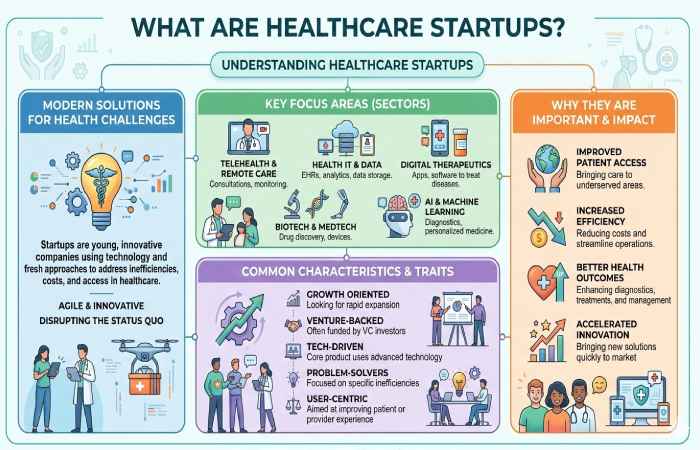
Healthcare startups are early-stage companies that use innovation, technology, and new business models to improve how healthcare is delivered, managed, or researched.
Unlike traditional healthcare organizations (hospitals, pharma giants, insurance companies), healthcare startups are typically:
- Technology-driven
- Fast-scaling
- Venture-funded
- Focused on solving specific healthcare problems
They operate at the intersection of medicine, data science, biotechnology, and digital technology.
Simple Definition
A healthcare startup is a newly founded company that develops innovative solutions to improve patient care, reduce medical costs, enhance diagnostics, accelerate research, or optimize healthcare systems.
Main Types of Healthcare Startups
| Category | Description | Example Startup | Typical Pricing | Resources & Links |
| Telemedicine & Virtual Care | Remote doctor consultations or healthcare services online through apps/video. | K Health | Subscription: ~$9–$25/month
Per consult: $20–$50+ |
https://en.wikipedia.org/wiki/K_Health |
| Digital Therapeutics (DTx) | Software platforms scientifically proven to prevent or treat diseases (therapy via app). | Lark Health | App or program cost: ~$100–$300/year
Some pay-per-module prices vary |
https://www.lark.com/ |
| AI-Powered Diagnostics | Use machine learning to interpret clinical images, scans, labs, etc. | Examples: AI radiology, cancer detection | Often enterprise pricing (B2B): $30K–$500K+ / year | https://startupbydoc.com/top-10-healthcare-startups-to-watch-in-2025/ |
| Remote Patient Monitoring (RPM) | Wearables and connected devices that track patient vitals remotely. | Examples: Biofourmis, Huma, InfoBionic | Devices: $50-$500+
RPM subscription: $20–$150+/month |
https://www.medicalstartups.org/top/remote-patient-monitoring/ |
| Electronic Health Records (EHR) & Practice Tools | Software to manage records, clinic workflow, and interoperability. | Examples: Practo, HealthPlix | Monthly fees per user: $30–$150+ | https://hospi.info/the-rise-of-health-tech-startups-and-innovation-in-the-industry/ |
| Wearables & IoMT (Internet of Medical Things) | Devices for continuous health tracking (ECG, glucose, pulse). | Apple Watch (med-grade), wearable startups | Wearables: $100–$500+ | https://www.businessoutreach.in/healthtech-startup-ideas-ai-in-healthcare/ |
| Genomics & Precision Medicine | Tailored treatments based on genetic or biological data. | Example startups: MedGenome (India), others | Genetic test kits: $199–$500+ | https://startupbydoc.com/top-10-healthcare-startups-to-watch-in-2025/ |
| Online Pharmacies & E-Health Platforms | Order medicines, book diagnostics + teleconsultations. | Tata 1mg | Medicine delivery cost varies
Diagnostics: $10–$100+ per test |
https://en.wikipedia.org/wiki/Tata_1mg |
| Chronic & Lifestyle Management Platforms | AI coaching for lifestyle or chronic diseases. | Examples: HealthifyMe, Sugar.fit | Monthly: $5–$50+ | https://whatnetworth.net/top-10-health-startups-in-india-revolutionizing-healthcare/ |
Top Healthcare Startups (worldwide) that are Redefining Innovation.
Nowadays, physical presence is no longer essential for physical therapy. SWORD Health has developed the world’s first digital therapist powered by AI, which remains based in Porto/San Francisco. The clinical team prescribes a personalized program to the patient that they can take home as per the assessment of rehabilitation needs. A highly accurate motion tracker that communicates data wirelessly to the virtual therapist remains fitted to the patient The digital therapist can then guide the patient through the correct exercises from a distance, ensuring that they are perform correctly.
Prognos Healthcare Startup

Focus: Predictive analytics & disease interception
Data Network: 13+ billion de-identified lab records
Key Capabilities:
- Early disease detection
- Care gap identification
- Population health management
- Pharma R&D analytics
Revenue Model:
- Enterprise SaaS licensing
- Insurance payer analytics packages
- Pharma data partnerships
Estimated enterprise contracts range from $100K–$1M annually depending on data scale. With the ambitious goal of eradicating disease, Prognos uses Artificial Intelligence and advanced data analytics to help predict disease as early as possible.
They have a vast network of labs with access to 13 billion patient records. And this data is enrich before it is AId for legal awareness. This registry helps detect patients at risk and develop treatment plans. Prognos also offers a solution for payers, who can use analytics to assess at-risk populations or members and identify “care gaps.”
Flatiron Health
Acquired By: Roche (2018, $1.9B)
Specialty: Oncology EHR + Real-world evidence
Core Products:
- Oncology-specific EHR
- Clinical trial matching
- Data analytics platform
- Life sciences data research
Business Model:
- Oncology clinics subscription fees
- Pharma research contracts
- Real-world evidence licensing
Flatiron Health is an oncology-focused electronic health record (EHR) company that works todoes cancer research and helps in the betterment of the patient health. They offer an EMR system that decreases time and costs, and also analytics stage that helps derive relevant insights from data, and a facility that screens patients for clinical trials. They work with hospitals, community clinics, universities and life sciences companies. Back by Alphabet, the company was bought by Roche in early 2018.
Fertilidad Moderna Healthcare Startups
Founded: 2017
Backed by: Y Combinator
Acquired by: Ro
Pricing Breakdown:
| Service | Price |
| At-Home Hormone Test | ~$159 |
| Traditional Clinic Fertility Test | $600–$1,200 |
| Online Consultation | Included |
Value Proposition:
- Affordable hormone testing
- App-based fertility tracking
- Nationwide lab partnerships via Quest Diagnostics
This San Francisco-based company offers a fertility hormone test that women can take at home. They have to take a simple finger prick test and return it by mail to get a doctor-approved report on their hormones and fertility profile. The company is associated with Quest Diagnostics, with more than 2,000 centres in the United States. Founded by two former executives from Uber and 23andME and also launched on Y Combinator, the company raised $6 million in May 2018.
California-Based Day two
Focus: Microbiome-driven personalized nutrition
How It Works:
- Stool sample analysis
- Blood glucose testing
- AI-generated diet plan
Pricing:
| Service | Estimated Cost |
| Microbiome Test | $299–$399 |
| Nutrition Program | Employer-sponsored / enterprise |
Day Two examines your gut microbiome and provides personalized nutrition advice. For instance, if you give a stool sample and a blood test report. The company profiles your gut microbiome at the genetic level, created which it recommends what foods you should and should not eat. In 2017, it obtained $12 million in financing from Johnson & Johnson, the Mayo Clinic and also other investors.
Health in Babylon

Headquarters: UK
Services: AI chatbot + virtual GP
Pricing Comparison:
| Service | Price |
| Babylon Subscription | ~$9–$25/month |
| Private GP Visit UK | £50–£150 |
| NHS GP Visit | Free |
Based in the United Kingdom, Babylon Health allows users to conduct virtual consultations with doctors and also health professionals through video/audio and text messages. Its AI-based chatbot can make recommendations and diagnoses and is intend to be an alternative to the NHS 111 service. Among its investors are the founders of DeepMind; the company raised $60 million in 2017 and claimed its AI system is on par with human doctors. So it won’t be long before we start consulting GPs with AI.
Arterys
Funding: $30M+
Focus: AI radiology imaging
Technology Highlights:
- Deep learning tumor detection
- Cloud-based imaging analysis
- FDA-cleared oncology tools
Pricing Model:
Enterprise radiology SaaS (custom pricing, often $50K–$500K annually depending on hospital size). Another company harnessing the power of AI, Arterys, calls itself the AI assistant for radiologists. This San Francisco-based company offers FDA-cleared AI software for oncology that helps radiologists. Measure and track tumours on MRI and CT scans using a simple browser to more accurately recognize cancer and speed. In addition, the software uses deep learning to notice lung and liver lesions. With an accuracy that is equal to segmentations performed by human experts. Arterys completed a $30M series B financing in 2017.
Feebris Healthcare
Focus: Early childhood disease detection
Use Case:
- Pneumonia detection via digital stethoscope
- AI-based community screening
- Low-resource setting support
This London company offers a mobile application that allows community diagnoses to be carry out on the young and children (under five years of age). It uses the data collected by digital stethoscopes and wearables. Intelligent algorithms remove insights from this data and drive disease diagnosis and prediction. One of its main applications is the detection of childhood pneumonia through a digital stethoscope that attaches to the Feebris platform. Fabric won the Big Ideas competition in April 2018 and also received £10,000 in funding and the support of an RGAx mentor.
What Is the Best Healthcare Business to Start?
There’s no single “best” healthcare business — it depends on your budget, location, expertise, and risk tolerance. But if we look at profitability, scalability, startup cost, and 2026 market demand, some healthcare businesses clearly outperform others. Below is a breakdown of the best healthcare businesses to start in 2026, categorized by investment level and growth potential.
1. Telehealth / Virtual Care Platform (High Growth, Scalable)
Why It’s Strong:
- Massive post-pandemic adoption
- Low physical infrastructure cost
- Subscription-based recurring revenue
- High investor interest
Startup Cost:
| Model | Estimated Cost |
| Basic Telemedicine App | $30,000 – $80,000 |
| Advanced AI-enabled Platform | $100,000 – $300,000 |
Revenue Model:
- Subscription ($10–$40/month)
- Per-consult fee ($20–$70)
- Employer contracts
Example:
Ro (Telehealth Unicorn)
Best for: Tech founders, investors, scalable business goals.
2. Home Healthcare Services (Low Risk, High Demand)

Why It’s Strong:
- Aging population globally
- Stable cash flow
- Insurance reimbursements
Startup Cost:
| Service Size | Estimated Cost |
| Small Local Agency | $20,000 – $50,000 |
| Full-Service Agency | $60,000 – $150,000 |
Revenue:
- $25–$75 per hour per patient
- $3,000–$6,000/month per long-term client
Best for: Healthcare professionals, low-tech markets, steady income seekers.
3. Medical Billing & Coding Company (Low Investment, High Margin)
Why It’s Strong:
- Every clinic needs it
- Remote business model
- High profit margins (20–40%)
Startup Cost:
| Model | Cost |
| Home-Based | $5,000 – $15,000 |
| Small Team | $20,000 – $40,000 |
Revenue:
- 4–10% of clinic revenue
- $1,000–$10,000 per client monthly
Best for: Beginners, low capital investors.
4. Healthcare Staffing Agency
Why:
- Global nurse shortage
- Hospitals outsource recruitment
- Recurring placement fees
Startup Cost:
$25,000 – $75,000
Revenue:
- 15–25% placement commission
- $10,000–$30,000 per nurse placement
5. AI Healthcare SaaS (High Risk, High Reward)
Examples include:
- AI diagnostics
- Remote monitoring platforms
- Predictive analytics tools
Startup Cost:
$100,000 – $500,000+
Potential:
- Unicorn-level scalability
- B2B enterprise contracts ($50K–$500K annually)
Best for: Technical founders with funding access.
6. Specialized Clinic (Dermatology, Physiotherapy, Dental)
Startup Cost:
$100,000 – $500,000+
Revenue Potential:
$500K–$2M annually depending on location
Higher risk due to:
- Rent
- Equipment
- Staff payroll
- Regulations
Top 10 Healthcare Startups in India — 2026
| Company | Location (HQ) | Services / Typical Pricing | Contact Info (Phone/Email) | Reviews / Notes | Resource Links |
| Practo | Bengaluru, KA | Doctor booking, teleconsult, diagnostics (consult ~₹100–₹500+) | Contact form on site (no public phone) | Widely used, strong user feedback on convenience | Practo Website |
| PharmEasy | Mumbai, MH | Online pharmacy, diagnostics; delivery fees vary | +91 226 293 2093
care@pharmeasy.in |
Mixed consumer review scores on service/support | PharmEasy About |
| Tata 1mg | Gurugram, HR | E-pharmacy, lab tests, e-consult (prices vary) | Contact via official site | Fast growing omnichannel health platform | Tata 1mg Wiki |
| MediBuddy | Noida, UP (services India-wide) | Telehealth + diagnostics + insurance | Contact via MediBuddy site | Popular for corporate health benefits | HealthBuzz List |
| Pristyn Care | Gurugram, HR | Minimally invasive surgery & care (procedure pricing varies) | Via official site | Rapidly growing surgical care startup | Pristyn Care Wiki |
| MFine | Bangalore, KA | On-demand doctor consults; lab test add-ons | Via MFine site | Strong hybrid online-offline offering | HealthBuzz List |
| Dozee | Bengaluru, KA | AI remote patient monitoring (device+subscription) | Contact via site | Hospital adoption growing fast | HealthBuzz List |
| Qure.ai | Mumbai, MH | AI imaging diagnostics (enterprise pricing) | Contact via Qure.ai site | Global deployment & rapid AI growth | HealthBuzz List |
| HealthifyMe | Bengaluru, KA | AI health & fitness app (premium ₹349–₹999/mo) | Contact via HealthifyMe app/site | Highly rated for wellness & coaching | StartupByDoc List |
| Niramai | Bengaluru, KA | AI breast cancer screening (test varies) | Contact via site | Innovative non-invasive diagnostic | Inventiva List |
Top Healthcare Companies In 2026 (Country-Wise)
United States – Top Healthcare Companies of 2026
| Company | Focus | Estimated Pricing | Headquarters | Website | Notes/Resources |
| UnitedHealth Group | Health insurance & care services | Insurance premiums vary by plan | Minnetonka, MN, US | https://www.unitedhealthgroup.com | Largest global healthcare company by market cap |
| Suki | AI digital assistants for clinics | Enterprise deployment — custom pricing | Redwood City, CA | https://www.suki.ai/ | AI voice-assistant for healthcare staff |
| GE HealthCare | Medical imaging & diagnostics | Equipment pricing varies widely | Chicago, IL, US | https://www.gehealthcare.com/ | Major medtech supplier |
For phone/email/contact: Visit “Contact Us” on official websites — most US healthtech/service providers require registration for specific pricing.
United Kingdom – Leading Healthcare Tech Firms 2026
| Company | Focus | Pricing | HQ | Website | Resources |
| Babylon Health | Virtual GP + AI diagnoses | Subscriptions ~£9–£25/mo | London, UK | https://www.babylonhealth.com | Ranked among leading UK healthtech |
| BenevolentAI | Drug discovery AI | Enterprise pricing | London, UK | https://www.benevolent.com/ | AI for drug R&D |
| Healx | Rare disease AI repurposing | Custom | Cambridge, UK | https://healx.com/ |
Contacts: Use official “Get in Touch” pages for inquiries; UK startups typically list email forms.
Germany – Key Healthcare Companies
| Company | Focus | Pricing | HQ | Website | Notes |
| Ada Health | AI symptom checker | Free basic app/free/paid features | Berlin, DE | https://ada.com/ | Global symptom assessment tool |
| Doctolib | Digital bookings & telehealth | Subscription (clinics) | Berlin/Paris | https://www.doctolib.de/ | One of Europe’s biggest |
| Medbelle | Digital hospital platform | Surgery care pricing on request | Berlin, DE | https://medbelle.de/ |
Reviews: Check Trustpilot/Google Reviews via company websites.
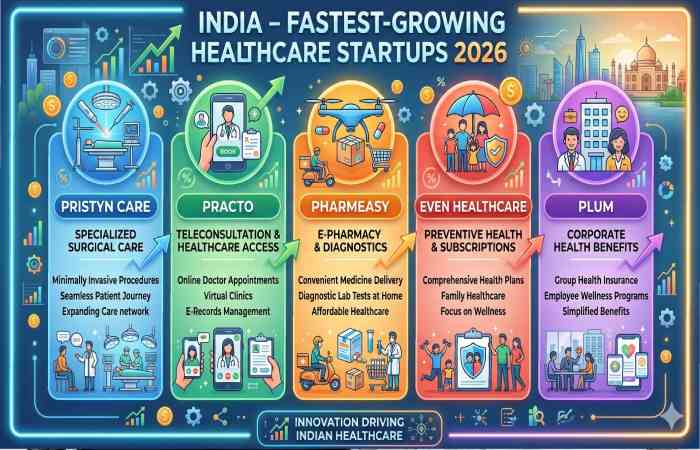
India – Fastest-Growing Healthcare Startups 2026
| Company | Focus | Typical Cost | HQ | Website |
| Pristyn Care | Elective surgery & care | Procedure-dependent pricing | Gurugram, India | https://www.pristyncare.com/ |
| Practo | Doctor bookings, telemedicine | Clinic fee + teleconsult fees | Bangalore, India | https://www.practo.com/ |
| PharmEasy | Online pharmacy | Medicines variable pricing | Mumbai, India | https://pharmeasy.in/ |
| Even Healthcare | Managed health care | Subscription + care pricing | Bengaluru, India | Link via web |
| Plum | Health insurance & wellness | Premium varies by plan | Bengaluru, India | https://www.plumhq.com/ |
Resource links: Use official websites for contact forms and clinic locations.
China – Leading Digital Health Platforms
| Company | Focus | Pricing | HQ | Website |
| WeDoctor | Online consult + appointments | User pays per consult | Hangzhou, China | https://www.wedoctor.com/ |
| Ping An Good Doctor | Telemedicine & health services | Subscription + consult | Shanghai, CN | https://www.pingan.com/ |
Comments: China platforms serve hundreds of millions and mainly price per service with in-app payments.
Australia – Innovation in HealthTech
| Company | Focus | Pricing | HQ | Website |
| Kismet Healthcare | Care management ecosystem | Custom enterprise pricing | Melbourne, AU | https://kismet.healthcare/ |
| Eucalyptus Health | Telehealth & online pharmacy | Service dependent | Sydney, AU | https://eucalyptus.health/ |
Contact & Reviews: Use official site contact pages; search Google Reviews for local feedback.
Sweden – Emerging HealthTech
| Company | Focus | Pricing | HQ | Website |
| Neko Health | Preventive body scanning | Scans ≈ $368 (~£299) | Stockholm, Sweden | https://nekohealth.com/ |
Tunisia – Growing Digital Healthcare
| Company | Focus | Pricing | HQ | Website |
| Docic | Digital patient records & online doctor connections | Free/basic app | Tunis, Tunisia | https://docic.net/ |
Singapore – HealthTech Innovation
| Company (Examples) | Focus | Pricing | Headquarters | Website |
| Kinex | AI digital health solutions | N/A | Singapore | Search via LinkedIn |
| iUvo Health | Predictive wellness wearables | N/A | Singapore | LinkedIn list |
Contacts: Startup LinkedIn pages list social emails.
France – Major Healthcare Platforms
| Company | Focus | Pricing | HQ | Website |
| Doctolib | Appointment booking & telehealth | Clinic subscriptions | Paris, FR | https://www.doctolib.fr/ |
Top Health Tech Unicorns (Global)
| Company | Country | Cluster | Unicorn Year | Last Round | Type | Valuation |
| Devoted Health | United States | Health Insurance | 2018 | Dec 2023 – $175M Series E | Digital Health | $12.9B |
| Biosplice Therapeutics | United States | Health Discovery | 2018 | Apr 2021 – $120M VC | Biotech | $12.0B |
| Tempus | United States | Precision Medicine | 2018 | Oct 2022 – $100M VC | Data/AI | $8.1B |
| Caris Life Sciences | United States | Precision Medicine | 2021 | Jan 2023 – $400M Debt | Genomics | $7.8B |
| Ro (Roman Health) | United States | Telehealth | 2020 | Feb 2022 – $150M VC | Virtual Care | $7.0B |
| Datavant | United States | Health Records | 2021 | Oct 2020 – $40M VC | Data Infrastructure | $7.0B |
| WeDoctor (Guahao) | China | Telehealth | 2015 | Feb 2021 – $411M Series F | Virtual Health | $7.0B |
| Doctolib | France | Bookings & Referrals | 2019 | Mar 2022 – $547M Series F | Practice Management | $6.4B |
| Hinge Health | United States | Specialist Care | 2021 | Oct 2021 – $400M Series E | Digital Therapeutics | $6.2B |
Frequently Asked Questions
What are early stage healthcare startups?
Early-stage healthcare startups are companies in:
- Pre-seed stage
- Seed funding stage
- Series A funding
They are usually:
- 1–5 years old
- Testing MVP (Minimum Viable Product)
- Building regulatory approvals
- Hiring early team members
Examples often include AI diagnostics startups, wearable tech founders, and telemedicine platforms before scaling.
Who are the big 3 in healthcare?
Globally, the “Big 3” healthcare companies (by revenue and influence) are typically:
- UnitedHealth Group – Health insurance & healthcare services (USA)
- CVS Health – Pharmacy, insurance & retail clinics (USA)
- McKesson Corporation – Pharmaceutical distribution (USA)
In India, major healthcare giants include:
- Apollo Hospitals
- Fortis Healthcare
- Max Healthcare
Which healthcare startup is most profitable in India?
E-pharmacy and digital consultation platforms such as PharmEasy and Tata 1mg generate high revenues due to large customer bases and recurring medicine orders. Profitability varies based on funding stage and operational costs.
How much does it cost to start a healthcare startup in India?
Startup costs depend on the model:
| Business Type | Estimated Investment |
| Telemedicine App | ₹20 lakh – ₹1 crore |
| Home Healthcare Agency | ₹10 lakh – ₹40 lakh |
| Medical Billing Service | ₹3 lakh – ₹15 lakh |
| AI HealthTech Platform | ₹1 crore – ₹5+ crore |
| Diagnostic Center | ₹50 lakh – ₹3 crore |
Are healthcare startups regulated in India?
Yes. Healthcare startups must comply with:
- Ministry of Health & Family Welfare regulations
- CDSCO (for medical devices & diagnostics)
- Telemedicine Practice Guidelines (2020)
- Data protection and IT compliance laws
Healthcare startups hiring
Many healthcare startups actively hire for:
- Software engineers
- Data scientists
- Medical coders
- Sales & operations managers
- Clinical researchers
You can check job openings on:
- Naukri.com
- AngelList (Wellfound)
- Company career pages
Startups like Practo, PharmEasy, and MediBuddy regularly post hiring updates.
Top healthcare startups (Global)
Some global leaders include:
- Ro (USA)
- Hinge Health (USA)
- Doctolib (France)
- Tempus (USA)
- WeDoctor (China)
Healthcare startups in Bangalore
Bangalore is India’s healthtech capital.
Bangalore benefits from:
- Strong VC funding
- Large IT talent pool
- Startup incubators
- Biotech ecosystem
What are the fastest-growing healthcare sectors in India?
- Telemedicine
- E-pharmacy
- AI diagnostics
- Remote patient monitoring
- Preventive & wellness tech
- Health insurance tech
How do healthcare startups make money?
Common revenue models include:
- Subscription plans
- Per-consultation fees
- Commission on medicine sales
- Enterprise SaaS licensing
- Insurance partnerships
- Corporate health packages
Is investing in healthcare startups profitable?
Healthcare is considered a recession-resistant sector due to consistent demand. However, startup investments carry risks and depend on:
- Regulatory approval
- Scalability
- Technology adoption
- Funding cycles
What is the future of healthcare startups in India?
The future trends include:
- AI-driven diagnostics
- Personalized medicine
- Wearable health tracking
- Digital hospitals
- Preventive healthcare platforms
- Rural telemedicine expansion
India’s digital health market is expected to grow significantly due to increasing smartphone penetration and government digital health initiatives.
Conclusion
Healthcare is a sector in which an enormous amount of data is generate and collected daily. With the help of data science, machine learning, and AI. We can now analyze this data and extract meaningful insights that will pave the way for further medical innovations. Moreover, with the digital revolution, the sector continues to grow at a dizzying pace.