


Crypto is volatile because its price is a bet on its future adoption. Future acceptance depends on several uncertain factors, one of the most important of which is the potential impact of regulation. So what exactly are the regulatory risks for cryptocurrencies, and how much have they increased following bear market failures like Terra/Luna? Learn crypto breaks it down into a clear set of topics.
- The environmental arguments for crypto regulation
- Regulate the nature of cryptocurrencies
- Joe Biden’s attempt to regulate digital assets
- Regulation of exchanges, non-hosted wallets, and stable coins
Table of Contents
What is Crypto?
Cryptocurrency is a decentralized digital asset system powered by blockchain technology. Unlike traditional currencies, it operates without central authorities like banks or governments.
Key Characteristics
- Decentralized networks (blockchain-based)
- Cryptographic security
- Limited supply (e.g., Bitcoin capped at 21M)
- Peer-to-peer transactions
- Borderless and censorship-resistant
Global Crypto Market Overview (2026)
| Metric | Value (Approx) |
| Total Market Cap | $2.2 Trillion+ |
| Number of Cryptos | 25,000+ |
| Daily Trading Volume | $80–120 Billion |
| Active Users | 450+ Million |
What is the Risk to Crypto from Regulation?
Regulation is one of the biggest external threats to crypto because it can directly influence:
- Market prices
- Adoption rates
- Innovation speed
- Investor confidence
At its core, crypto’s value depends heavily on future acceptance, and regulation can either accelerate or restrict that future.
Key Regulatory Risks to Crypto
1. Bans & Restrictions
What happens:
Governments may ban or limit crypto usage, trading, or mining.
Examples:
- Complete bans (e.g., some countries restrict crypto entirely)
- Restrictions on exchanges or wallets
Impact:
- Sharp price drops
- Reduced liquidity
- Investor panic
Even rumors of bans can trigger mass sell-offs
2. Classification Risk (Security vs Asset)
The Issue:
Governments must decide:
- Is crypto a currency?
- A commodity?
- Or a security?
Why it matters:
If classified as a security:
- Projects must follow strict financial laws
- Many tokens could become illegal overnight
Impact:
- Thousands of altcoins could disappear
- Increased compliance costs
3. Taxation Policies
Current Trends:
- High taxes on crypto gains (e.g., 30% in some countries)
- No loss offset benefits
- Strict reporting requirements
Impact:
- Reduced investor participation
- Lower trading volume
- Shift to offshore platforms
4. KYC & Privacy Regulations
What is happening:
Governments require:
- Identity verification (KYC)
- Transaction monitoring
Impact:
- Loss of anonymity
- Reduced appeal of decentralized finance (DeFi)
- Increased surveillance
5. Regulation of Exchanges & Wallets
Key Areas:
- Centralized exchanges (CEXs)
- Non-custodial wallets
- Stablecoins
Possible Rules:
- Licensing requirements
- Reserve audits
- Transaction limits
Impact:
- Smaller exchanges may shut down
- Reduced innovation
- Market consolidation
Top Cryptocurrencies by Market Value
| Rank | Cryptocurrency | Symbol | Price (USD) | Market Cap | Use Case |
| 1 | Bitcoin | BTC | $60,000+ | $1.1T | Store of Value |
| 2 | Ethereum | ETH | $3,000+ | $360B | Smart Contracts |
| 3 | Tether | USDT | $1.00 | $100B+ | Stablecoin |
| 4 | BNB | BNB | $550+ | $80B | Exchange Token |
| 5 | Solana | SOL | $140+ | $60B | Fast Blockchain |
Crypto Price Comparison by Country
| Country | BTC Price (Local) | Premium/Discount | Popular Exchanges | Resource |
| India | ₹52,00,000 | +2% Premium | WazirX, CoinDCX | https://wazirx.com |
| USA | $60,000 | Standard | Coinbase, Kraken | https://coinbase.com |
| UK | £47,500 | +1% Premium | Binance UK | https://binance.com |
| Japan | ¥9,000,000 | +3% Premium | bitFlyer | https://bitflyer.jp |
| Nigeria | ₦95,000,000 | +5–10% Premium | Binance P2P | https://binance.com |
Types of Cryptocurrencies
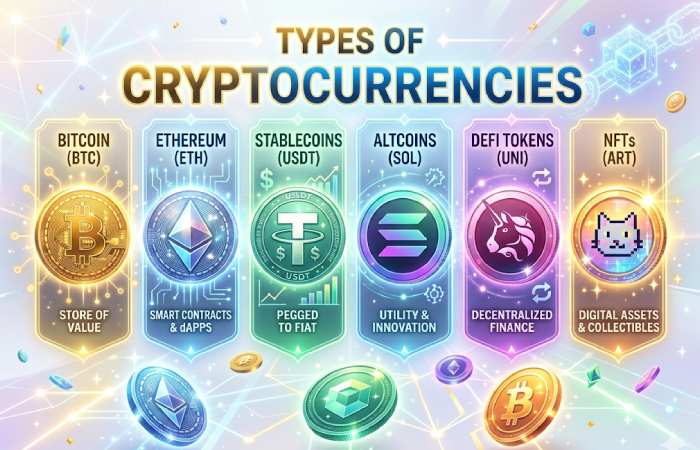
- Payment Coins
- Bitcoin (BTC)
- Litecoin (LTC)
- Smart Contract Platforms
- Ethereum (ETH)
- Solana (SOL)
- Stablecoins
- USDT, USDC
- Pegged to fiat currencies
- Meme Coins
- Dogecoin (DOGE)
- Shiba Inu (SHIB)
- Utility Tokens
- Used within ecosystems (BNB, LINK)
Crypto vs Traditional Finance
| Feature | Crypto | Traditional Finance |
| Control | Decentralized | Centralized |
| Speed | Instant/Minutes | Hours/Days |
| Fees | Low–Medium | Medium–High |
| Transparency | High | Limited |
| Accessibility | Global | Restricted |
Crypto vs Traditional Finance
| Feature | Crypto (Blockchain Finance) | Traditional Finance (Banks & Institutions) |
| Transaction Fees | $0.01 – $50 (network dependent) | $10 – $50 (wire transfer) |
| International Transfer Cost | $1 – $5 (avg Bitcoin) | 2% – 7% of amount + $30–$50 fees |
| Currency Conversion Fees | 0% – 1% (stablecoins) | 2% – 5% FX markup |
| Transaction Speed | Seconds – Minutes | 1 – 5 Business Days |
| Availability | 24/7/365 | Limited (bank hours, holidays) |
| Account Fees | $0 (no maintenance) | $5 – $25/month |
| Overdraft Fees | None | ~$35 per transaction |
| Trading Fees | 0.1% – 0.3% (DEX/CEX) | $0 – $10 per trade + spread |
| Credit Card Fees | Not applicable / low | 2% – 3% per transaction |
| Transparency | High (blockchain visible) | Low (hidden fees common) |
| Security Model | User-controlled (private keys) | Bank-controlled (insured systems) |
| Reversibility | Irreversible | Reversible (chargebacks) |
| Accessibility | Global, no bank needed | Requires bank account |
| Inflation Control | Fixed supply (BTC) | Controlled by central banks |
Top Crypto Exchanges Comparison
| Exchange | Fees | Supported Coins | Best For | Link |
| Binance | 0.1% | 350+ | Low fees | https://binance.com |
| Coinbase | 1–2% | 200+ | Beginners | https://coinbase.com |
| Kraken | 0.16% | 200+ | Security | https://kraken.com |
| WazirX | 0.2% | 250+ | India users | https://wazirx.com |
| KuCoin | 0.1% | 700+ | Altcoins | https://kucoin.com |
Regulatory Landscape by Region
| Region | Regulation Status | Key Notes |
| USA | Strict | SEC involvement |
| EU | Moderate | MiCA framework |
| India | Tax-heavy | 30% tax on gains |
| China | Ban | Crypto illegal |
| UAE | Friendly | Crypto hubs emerging |
Crypto Investment Strategies

Dollar-Cost Averaging (DCA)
What it is:
Invest a fixed amount at regular intervals (weekly/monthly), regardless of price.
Example:
- Invest ₹5,000/month in Bitcoin
- Buy more when price is low, less when high
Pros
- Reduces volatility risk
- Beginner-friendly
- No need to time the market
Cons
- Lower returns in bull markets
Best For:
Beginners
Long-term investors
HODLing (Buy & Hold)
What it is:
Buy strong cryptocurrencies and hold for years.
Example Assets:
- Bitcoin (store of value)
- Ethereum (smart contracts)
Pros
- Simple strategy
- Historically high returns
- Low effort
Cons
- Requires patience
- High drawdowns in bear markets
Ideal Timeline:
3–10 years
Swing Trading
What it is:
Buy low, sell high based on short-to-medium trends.
Example:
- Buy when BTC dips 10%
- Sell after 15–25% rise
Pros
- Higher profit potential
- Works in volatile markets
Cons
- Requires technical analysis
- Risk of losses
Tools Needed:
- Charts (TradingView)
- Indicators (RSI, MACD)
Day Trading
What it is:
Multiple trades within a single day.
Typical Profit Target:
1% – 5% per trade
Pros
- Fast profits
- High liquidity
Cons
- Very risky
- Time-intensive
- Requires experience
Staking (Passive Income)
What it is:
Lock your crypto to support a blockchain and earn rewards.
Returns:
- 4% – 15% APY
Popular Coins:
- Ethereum
- Solana
- Cardano
Pros
- Passive income
- Lower risk than trading
Cons
- Lock-up periods
- Price volatility risk
Crypto Risks (Expanded)
Market Risks
- Extreme volatility
- Liquidity issues
Regulatory Risks
- Government bans
- Tax changes
Technical Risks
- Hacks & exploits
- Smart contract bugs
Environmental Impact of Crypto
Key Facts
- Bitcoin mining consumes energy comparable to small countries
- Transition to Proof-of-Stake reduces energy by ~99%
Comparison Table
| Mechanism | Energy Use | Example |
| Proof of Work | High | Bitcoin |
| Proof of Stake | Low | Ethereum 2.0 |
Institutional Adoption of Crypto
Major Companies Involved
- Tesla (BTC holdings)
- PayPal (crypto payments)
- BlackRock (crypto ETFs)
Future Trends in Crypto (2026–2030)
The crypto industry is transitioning from speculation → infrastructure → global financial system. Between 2026 and 2030, major transformations will reshape how money, assets, and digital ownership work.
Massive Market Growth & Valuation Explosion
Key Forecasts
- Crypto market could reach $5–10 trillion by 2026
- Potential to hit $10+ trillion by 2030
- Blockchain market projected up to $393B–$1.4T by 2030
What This Means
- Crypto becomes a core asset class like stocks & gold
- More institutional money flows into the market
- Reduced volatility over time (mature markets)
Institutional Adoption Goes Mainstream
Key Drivers
- Banks offering crypto custody services
- Crypto ETFs and regulated products
- Corporate treasury adoption
Institutions are already integrating crypto into financial systems, transforming it into a regulated asset class
Trend Impact
- Increased trust among retail investors
- Large-scale capital inflow
- Professionalization of crypto markets
Stablecoins Become Global Payment Infrastructure
Key Insights
- Stablecoins already process $1.25 trillion monthly volume
- Expected to become the “internet’s dollar”
Future Use Cases
- Cross-border payments
- Salary payments in crypto
- E-commerce transactions
Tokenization of Real-World Assets (RWA Boom)
What is Tokenization?
Turning real-world assets into blockchain-based tokens.
Examples
- Real estate
- Stocks & bonds
- Commodities
Growth Potential
- Tokenized funds could reach $400B–$1T by 2030
Why It Matters
- Fractional ownership
- 24/7 trading
- Increased liquidity
AI + Crypto Integration
Emerging Trends
- AI-powered trading bots
- Smart contract automation
- Fraud detection & security
AI + blockchain will create new digital asset categories and demand drivers
Future Vision
- “Decentralized AI economies”
- Autonomous financial systems
Competitor Analysis (Top Content Pages Insights)
| Platform | Strength | Weakness |
| Investopedia | Detailed education | Less updated prices |
| CoinMarketCap | Real-time data | Less beginner-friendly |
| Binance Academy | Free learning | Biased toward Binance |
| CoinGecko | Accurate metrics | Complex UI |
Crypto Use Cases
Real-World Applications
- Payments & remittances
- NFTs & digital ownership
- Gaming (Play-to-Earn)
- Supply chain tracking
- Decentralized finance (DeFi)
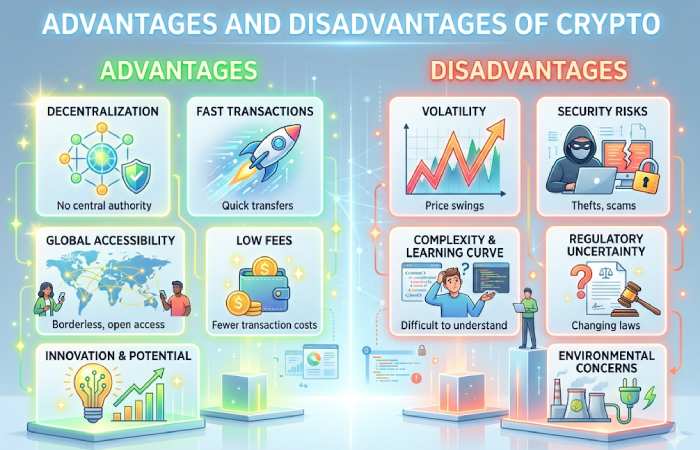
Advantages and Disadvantages of Crypto
Conclusion
Cryptocurrency, sometimes called cryptocurrency or crypto. Is any form of currency that exists digitally or virtually and uses cryptography to secure contacts. Cryptocurrencies do not have a central allotting or regulatory authority; instead of using a decentralized system to record transactions and issue new units.