Table of Contents
Introduction
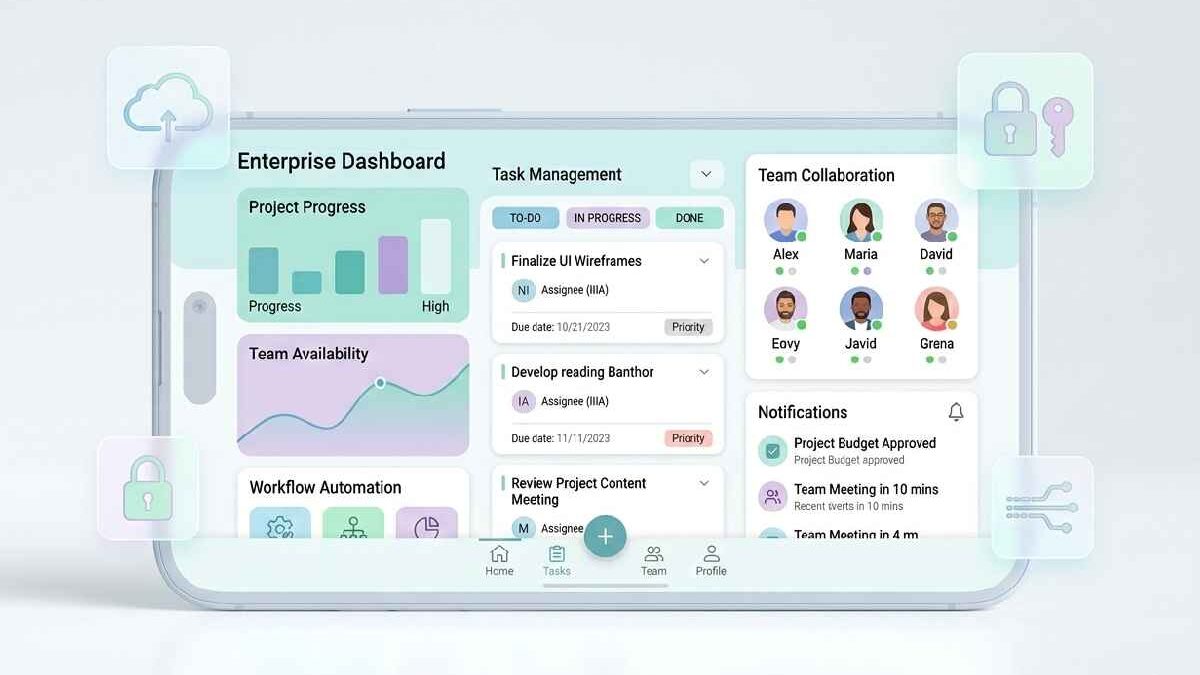
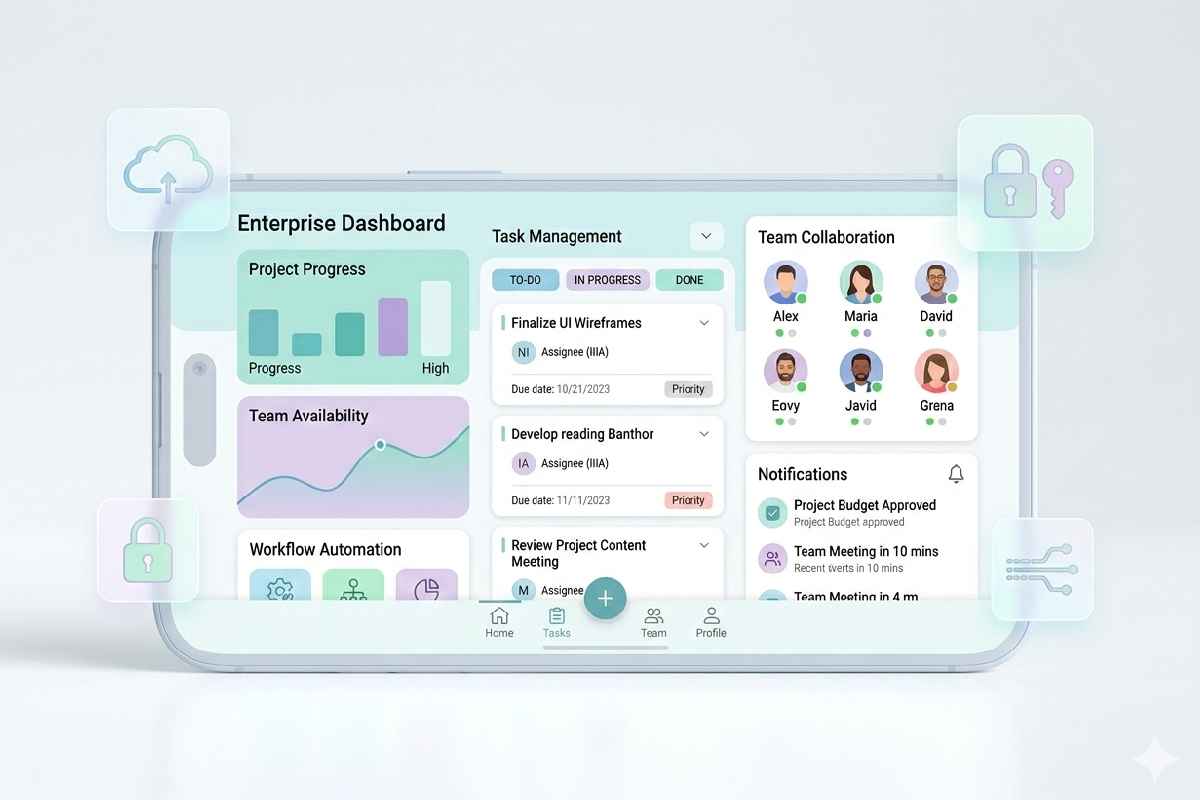
Every field worker’s dream is to access an enterprise mobile app from a smartphone. Plus, having a mobile business app at your fingertips benefits everyone involved, including employees, business owners, and customers. Workflow automation, increased workforce efficiency, and the ability to stay ahead of market competition are just a few benefits of successful application development corporate mobiles.
What is Enterprise Mobile App Development?
Enterprise Mobile App Development is the process of designing, building, integrating, and maintaining mobile applications specifically created for business operations. Unlike consumer apps built for mass audiences, enterprise apps are developed to support internal workflows, improve employee productivity, streamline operations, and securely manage business data.
These applications are typically used by employees, managers, partners, or stakeholders and are integrated with core enterprise systems such as CRM, ERP, HRM, and business intelligence platforms.
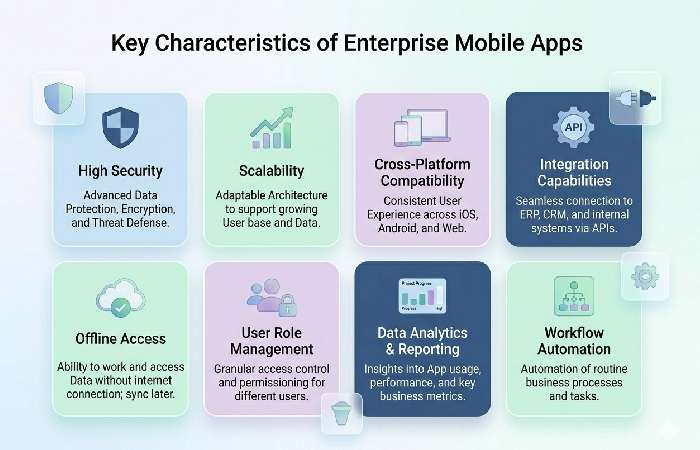
Key Characteristics of Enterprise Mobile Apps
How is Mobile App Development Different for Businesses?
Enterprise mobile application development is the process of creating a mobile application for the needs of a business. A business application’s users are mainly the organization’s employees, and their goal is to optimize business operations. Since enterprise apps differ from consumer mobile apps, their development also differs.
Like any other enterprise system, enterprise applications manage databases and frequent data transfers. For this reason, they must be designed for high security and scalability. Additionally, mobile apps for a business need to be consistent across all devices and platforms, even more so than consumer apps, because mistakes can cost the company dearly.
In addition, testing, automating builds, and integrating an application into the enterprise infrastructure are particularities. Additionally, enterprise application development differs in application distribution and legal considerations. This is because you follow app marketplace policies, such as the App Store review guidelines.
Types of Enterprise Mobile Apps
| Type of Enterprise Mobile App | Description & Key Features | Estimated Cost / Pricing | Resource / Reference Link |
| CRM (Customer Relationship Management) | Track leads, sales data, customer interactions, reporting, analytics | Development: $80,000 – $150,000+ Platform subscription: ~$25 – $299/user/month |
CRM apps often include sales automation, reporting capabilities. |
| ERP (Enterprise Resource Planning) | Centralized management of inventory, finance, HR, operations | Development: $150,000 – $500,000+ SaaS ERP mobile access varies by vendor |
ERP systems integrate all enterprise functions on mobile. |
| Employee Productivity / Collaboration | Internal chat, file sharing, meetings, team tasks | Subscription: $6 – $30+/user/month Custom app: $40,000 – $120,000 |
Includes messaging, task boards, training modules. |
| Field Service & Task Management | Manage field jobs, update job status, GPS tracking, offline data | Development: $80,000 – $250,000+ | Field apps help mobile workers update work orders & capture data. |
| Business Intelligence (BI) & Analytics | Dashboards, reporting, real-time performance insights | Development: $90,000 – $300,000+ Power BI / Tableau Mobile subs start ~$10+/user/mo |
These apps deliver decision metrics on the move. |
| Human Resources (HR) & Payroll | Onboarding, leave requests, payroll info, performance tracking | Development: $50,000 – $200,000+ HR SaaS: ~$6 – $15+/user/mo |
Mobile HR streamlines employee data & approvals. |
| Inventory & Supply Chain Management | Stock tracking, supplier portals, order fulfillment, barcode scanning | Development: $100,000 – $350,000+ | SCM apps boost operational visibility. |
| Accounting & Billing Systems | Mobile invoicing, payment processing, receipts, reports | Development: $40,000 – $180,000+ | Finance mobile apps reduce manual billing. |
| Point-of-Sale (POS) Systems | Mobile checkout, inventory sync, sales reporting | Subscription POS: ~$29 – $99+/mo/user | POS on mobile enables sales anywhere. |
| Customer Support / Service Desk | Ticket tracking, agent replies, escalation workflows | SaaS support tools: ~$29 – $60+/user/mo | Great for service teams on the road. |
| Enterprise Messaging & Internal Communication | Secure chat, voice/video, file sharing | Subscription tools: $5 – $20+/user/mo | Messaging apps enhance collaboration. |
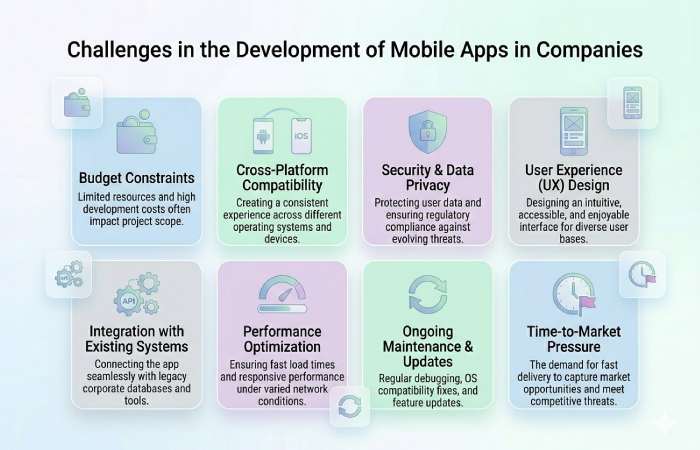
Challenges in the Development of Mobile Apps in Companies
You’ll encounter several challenges on the road to successfully launching a corporate mobile app. Let’s take a closer look at the main ones.
API Strategy
A mobile app communicates with company servers through APIs, so having the right API strategy in place is essential. Unfortunately, an API design that balances great end-user user experience and security are elusive. Still, it’s crucial for a mobile business app. Because an enterprise application’s API is integrated with business functions, it must adhere to high security standards.
Slow App Development
To start a mobile business app from scratch, you must prepare for a long-term development project. The good news is that your team can benefit from reusable components in low-code development. Or they can use MEAP (Mobile Enterprise Application Platform). It allows you to create cross-platform mobile applications and link them to business services. Also, you can speed up your software development with a dedicated development team to increase your development capacity.
Integration with Backend Resources
Integrating a new mobile app into existing backend services can be a real challenge. The fact is that large companies often have outdated backend services, which slows down development speed and causes problems. In some cases, integrating a mobile application with the service may not even be possible.
Application Distribution
Mobile app distribution differs from regular software distribution. There is no master copy of the app, and the entire process is routed through the app marketplaces. It leads to additional legal work required for enterprise mobile app distribution.
Security
Security is a priority for a mobile application. However, the challenge is to make the application as secure as possible, from safely storing user data to minimizing vulnerabilities in the operating system.
What to Consider Before Creating a Mobile Application?
Before jumping straight into designing and developing enterprise applications, consider the following points.
Business Goals
You need to know what kind of product your business needs and how it aligns with current business goals. So, before investing in app development, you need to understand what you want to achieve with a mobile app. Then, ask yourself who will use it and how. Finally, your application’s functionality and success depend partly on how you define your business application development goals.
Management
The development of mobile enterprise applications is a complex process. Besides the development team’s efforts, it requires a lot of administrative and legal work on the company’s part. So, before looking for software developers, it’s best to decide who will be in charge of them. Also, remember that employees must be train to use the business application.
Security
Bringing business apps to employees’ mobile devices means risking company data. In this regard, you should be aware of potential security issues and create a bulletproof system. Your employees need to be able to log into the App Market and be able to transfer all information securely without compromising company information.
Integration with Other Apps
Deciding whether or not to integrate your mobile business app with other apps is a decision you must make upfront. For example, you might need to integrate the corporate mobile app with other apps that your employees are currently using. Take a CRM (customer relationship management) system like Hubspot or Salesforce, for example.
Choose Platform
It would help if you decided which platforms your line-of-business application will run on and plan your development accordingly. For example, if your employees use the corporate mobile app on their devices, you should opt for cross-platform mobile development. It is how the mobile business app works on different devices and platforms.
Enterprise Mobile App Development Cost (2026)
Cost varies based on complexity, integrations, compliance, and region.
Development Cost Breakdown
| App Complexity | Features Included | Estimated Cost (India) | Estimated Cost (US/Europe) | Timeline |
| Basic | Internal workflow, login, dashboard | $15,000 – $30,000 | $40,000 – $80,000 | 3–4 months |
| Medium | CRM integration, APIs, analytics | $30,000 – $70,000 | $80,000 – $150,000 | 4–7 months |
| Complex | ERP, AI, IoT, real-time sync | $70,000 – $150,000+ | $150,000 – $400,000+ | 7–12 months |
Enterprise App Development Platforms Comparison
India – Enterprise App Platforms
| Platform | Type / Best For | Typical Pricing (India) | Notes & Resources |
| Microsoft Power Apps | Low-code with MS Ecosystem | ₹1,800 – ₹3,500/user/month | Strong with MS tools; SKU varies by connectors. |
| Zoho Creator | Low-code for SMEs | ₹1,000 – ₹2,500/user/month | Good for workflows & mobile forms. |
| Retool | Internal tools / dashboards | ₹2,000 – ₹8,000/user/month | Flexible but pricing increases with scale. |
| OutSystems | Full enterprise mobile & web | ₹40,000+/month | Enterprise scale, rich capabilities. |
| Appian | Complex workflows & automation | Enterprise price | Strong for process apps, quote-based. |
Notes: Indian pricing here is typically platform subscription per user or per month; enterprise editions and large teams may negotiate discounts.
United States – Enterprise App Platforms
| Platform | Type / Best For | Estimated Pricing (US) | Notes & Resources |
| Power Apps | Low-code (MS-centric) | ~$20/user/month (starts) | Enterprise licensing scalable; premium connectors add cost. |
| Mendix | Low-code (complex apps) | ~$1,875+/month base | Cloud native, enterprise use. |
| OutSystems | High-scale enterprise | ~$1,500+/month base | Enterprise mobile + web. |
| Salesforce Lightning | App platform on CRM | ~$25/user/month | Best for Salesforce data apps. |
| ServiceNow App Engine | Workflow + enterprise apps | Quote-based | Premium workflow automation; enterprise focus. |
US Pricing: Most enterprise plans are quoted by user tiers, environment types (dev/test/prod), and support level.
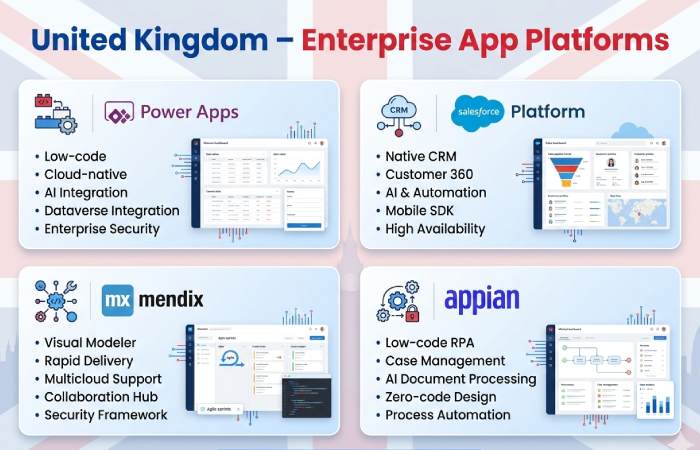
United Kingdom – Enterprise App Platforms
| Platform | Type / Best For | Typical Pricing (UK) | Notes & Resources |
| Microsoft Power Apps | Low-code | ~£20/user/month+ | Works well with Office365 in UK enterprises. |
| Mendix | Enterprise low-code | ~£1,500+/month | UK users benefit from European datacenters. |
| OutSystems | Complex enterprise | ~£1,500+/month | For high-scale projects. |
| Salesforce Lightning | CRM + app dev | ~£25/user/month | Enterprise CRM integration. |
| Appian | Automation + workflow | Quote-based | Enterprise workflow heavy. |
UK Insight: UK pricing often aligns closely with EU and US enterprise tiers, though individual quotations vary by scale.
Australia – Enterprise App Platforms
| Platform | Type / Best For | Estimated Pricing (AUS) | Notes & Resources |
| Power Apps | Low-code | ~$20/user/month+ | Popular due to MS ecosystem adoption. |
| OutSystems | Full enterprise | ~$1,500+/month | Enterprise level capabilities. |
| Mendix | Collaborative dev | ~$1,875+/month | Works well for complex apps. |
| Salesforce Lightning | CRM & apps | ~$25/user/month | High adoption in ANZ. |
| Appian | Enterprise workflow | Quote-based | Often value for automation. |
Note: Enterprise adoption in Australia parallels US/UK models, with larger vendor pricing due to regional support costs.
Singapore – Enterprise App Platforms
| Platform | Type / Best For | Estimated Pricing (SGD) | Notes & Resources |
| Power Apps | Low-code | ~S$25/user/month+ | Great for enterprises using MS stack. |
| OutSystems | Enterprise suite | ~$3,000+/month | Enterprise mobile & web. |
| Mendix | Enterprise low-code | ~$3,000+/month | Strong automation & governance. |
| Salesforce Lightning | CRM-linked apps | ~S$35/user/month | CRM + app builder combo. |
| Appian | Workflow + mobile apps | Quote-based | Focused on complex enterprise workflows. |
Singapore Insight: Enterprise pricing in APAC can be higher due to cloud region costs and support SLAs; many orgs negotiate local contracts.
Enterprise Mobile App Architecture Models
Native Architecture
- Best performance
- High security
- Higher development cost
Cross-Platform (React Native / Flutter)
- Faster development
- Lower cost
- Easier maintenance
Progressive Web Apps (PWA)
- Browser-based
- Cost-effective
- Limited device features
Security & Compliance Frameworks
Enterprise apps must comply with industry standards:
| Industry | Compliance |
| Healthcare | HIPAA |
| Finance | PCI-DSS |
| Europe | GDPR |
| India | DPDP Act |
| Global Security | ISO 27001 |
Enterprise Security Must-Haves
- End-to-end encryption
- Multi-factor authentication
- Biometric login
- Secure API gateway
- MDM (Mobile Device Management)
- Zero-trust architecture
ROI & Business Impact
Measurable Benefits
| Benefit | Impact Percentage |
| Productivity Increase | 25–40% |
| Operational Cost Reduction | 15–30% |
| Error Reduction | 20–35% |
| Faster Decision-Making | 30% |
| Employee Engagement Boost | 20% |
Average ROI timeframe: 12–18 months
Enterprise Mobile App Tech Stack (2026)
| Layer | Technologies |
| Frontend | React Native, Flutter, Swift, Kotlin |
| Backend | Node.js, .NET, Java Spring Boot |
| Database | PostgreSQL, MongoDB, Firebase |
| Cloud | AWS, Azure, Google Cloud |
| DevOps | Docker, Kubernetes, CI/CD pipelines |
Enterprise App Maintenance Cost
After launch, ongoing costs apply.
| Service | Annual Cost Estimate |
| Hosting & Cloud | $5,000 – $25,000 |
| Security Updates | $3,000 – $10,000 |
| Feature Updates | 15–20% of initial cost |
| Support & Monitoring | $5,000 – $20,000 |
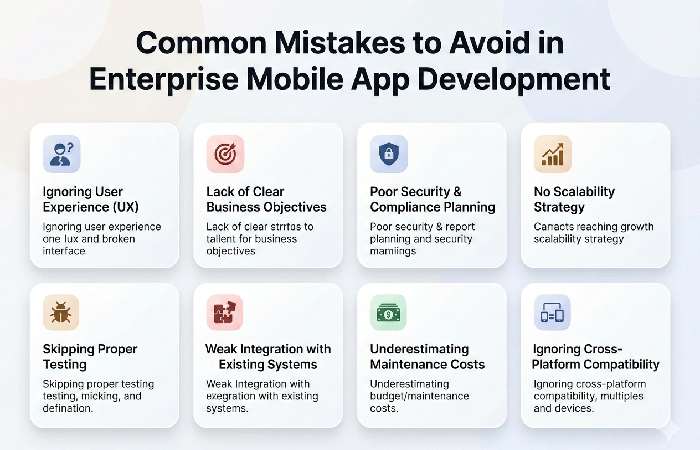
Common Mistakes to Avoid
Enterprise Mobile App Development Lifecycle
- Requirement Analysis
- Market & Competitor Research
- Architecture Planning
- UI/UX Design
- Backend & API Development
- Mobile App Development
- Testing & Automation
- Deployment
- Employee Training
- Ongoing Maintenance
Enterprise Mobile App Trends (2026)
It continue evolving rapidly as organizations digitize workflows, adopt new technologies, and empower distributed workforces. Below is a well-researched, forward-looking set of trends shaping enterprise mobile apps in 2026, with explanations, real use cases, and links to learn more.
AI & Machine Learning Embedded in Enterprise Apps
AI isn’t optional — it’s becoming a core part of enterprise apps.
Use Cases
- Smart predictive suggestions for field workers
- Automated data tagging & reporting
- AI-powered chatbot support
- Intelligent workflow automation
Benefits
- Faster decision-making
- Reduced manual work
- Better personalization for employee roles
Example: Apps that predict when a machine needs maintenance based on usage patterns.
Learn More: https://www.forbes.com/sites/forbestechcouncil/2024/01/15/how-ai-is-transforming-enterprise-mobile-apps/
Low-Code & No-Code Platforms
Enterprises are using low-code platforms to speed up app delivery and cut development costs.
| Platform | Popularity | Typical Pricing |
| OutSystems | High | Custom enterprise pricing |
| Microsoft Power Apps | Very High | $20 – $40/user/month |
| Mendix | High | Custom enterprise pricing |
| Salesforce Lightning | High | ~$25 – $300/user/month |
Benefits
- Faster releases
- Better collaboration between business & IT
- Less dependency on specialized developers
Learn More: https://www.gartner.com/en/newsroom/press-releases/2025-01-low-code-hype
Cross-Platform & Multi-Experience Development
Enterprises prefer one codebase that works everywhere.
Popular frameworks:
- Flutter
- React Native
- Xamarin
Benefits
- Shorter development cycles
- Lower long-term maintenance cost
- Consistent UI across devices
Learn More: https://www.techrepublic.com/article/cross-platform-mobile-app-dev-enterprise/
Mobile Security Gets Smarter (Zero Trust & Beyond)
Security is a top priority — especially as employees access sensitive data on mobile.
Key Security Trends:
- Zero Trust Architecture
- Hardware Attestation
- Biometric & Passwordless Login
- Secure APIs & Microservices
Priority Shift
Security spending continues to grow faster than app development spending itself.
Learn More: https://www.csoonline.com/article/mobile-security-enterprise-best-practices
Augmented Reality (AR) in Enterprise Operations
AR is no longer “cool tech” — it’s practical for enterprise mobile apps.
Use Cases
- Remote guided support (e.g., field equipment repair)
- Real-time AR training overlays
- Interactive product demos for sales teams
Learn More: https://www.techradar.com/news/ar-in-enterprise
Enterprise vs Consumer Mobile Apps
| Aspect | Enterprise Mobile App | Consumer Mobile App | Resource / Reference Link |
| Purpose | Improve business operations, workflow automation, employee productivity | Mass user engagement, entertainment, social interaction | https://www.antino.com/blog/enterprise-mobile-app-development |
| Target Users | Organization employees / partners | General public / consumers | https://www.mobindustry.net/blog/enterprise-vs-consumer-apps |
| Primary Goal | Maximize operational efficiency | Maximize downloads & engagement | https://devtrust.biz/resources/blog/enterprise-mobile-app-development-guide |
| Key Features | Secure login, internal APIs, role-based access, data sync | Social features, personalization, ads & engagement tools | https://www.designrush.com/agency/mobile-app-design-development/trends |
| Security Requirements | High (encryption, MDM, SSO, compliance) | Moderate (standard app store policies) | https://ideausher.com/blog/enterprise-mobile-app-development |
| Integration Level | Deep backend systems: ERP, CRM, BI | Light integrations (APIs, social, maps) | https://www.adspub.online/enterprise-mobile-apps |
| Development Cost (Approx) | Medium: $30,000 – $500,000+ • Complex: $150,000+ | Simple: $10,000 – $150,000 • Complex consumer: $150,000+ | https://www.antino.com/blog/enterprise-mobile-app-development |
| Maintenance Cost / Year | ~$15,000 – $100,000+* | ~$5,000 – $50,000+* | https://ideausher.com/blog/mobile-app-maintenance |
| Time to Build | ~3 – 12+ months | ~2 – 9 months | https://www.mobindustry.net/blog/app-development-timeline |
| Distribution Strategy | App store + Internal Deployment (MDM, corporate portal) | Public distribution via App Store / Play Store | https://devtrust.biz/resources/blog/enterprise-mobile-app-development-guide |
| Monetization Methods | Usually internal — cost savings, productivity ROI | Subscriptions, ads, in-app purchases | https://www.designrush.com/agency/mobile-app-design-development/trends |
| Compliance Needs | High — GDPR, HIPAA, PCI, industry protocols | App store policies + relevant data privacy laws | https://www.adspub.online/enterprise-mobile-apps |
| User Support | Dedicated support teams | Helpdesk, community, automated support | https://www.antino.com/blog/enterprise-mobile-app-development |
| Performance Priorities | Reliability, security, uptime | Speed, UI/UX, engagement | https://devtrust.biz/resources/blog/enterprise-mobile-app-development-guide |
| Feature Update Frequency | Scheduled enterprise releases | Frequent product updates & experiments | https://www.mobindustry.net/blog/app-development-trends |
| Examples | Field Service app, HR & payroll, ERP access | Social media, games, eCommerce apps | https://ideausher.com/blog/enterprise-mobile-app-examples |
Notes on Pricing
| Category | Enterprise App Price Range | Consumer App Price Range |
| Simple Internal App | $30,000 – $60,000 | $10,000 – $30,000 |
| Mid-level (APIs + Analytics) | $60,000 – $150,000 | $30,000 – $120,000 |
| Complex (ERP/AI/Offline) | $150,000 – $500,000+ | $120,000 – $300,000+ |
| Maintenance (Annual) | 15–20% of Dev Cost | 10–15% of Dev Cost |
Future Outlook
Enterprise mobile apps are evolving into intelligent operational systems rather than simple workflow tools. Businesses investing in scalable architecture, secure APIs, and cloud-native design are seeing long-term digital transformation benefits.
If optimized properly with strong SEO (technical guides, pricing transparency, industry-specific insights), this keyword can generate high-value B2B traffic because decision-makers actively search for:
- Enterprise mobile app development cost
- Enterprise app security standards
- Best enterprise app platforms
- Custom enterprise app development services
Conclusion
It is a sophisticated software system designed to meet the organization’s specific needs. This app should be built by a company’s overall strategy and make certain features available on mobile devices. Enterprise mobile app development process to develop user-friendly software that uses multiple complex data types and adheres to the latest security standards.